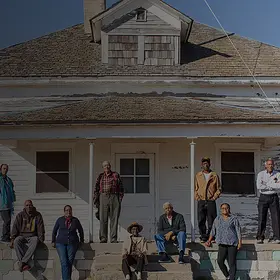
The National Trust for Historic Preservation Presents National Preservation Award to the V-Site Restoration Project in Los Alamos, New Mexico

Preserving Atomic History

Today, the National Trust for Historic Preservation presented the V-Site Restoration Project in Los Alamos, NM its National Trust/ACHP Award for Federal Partnerships in Historic Preservation. The project was one of 21 national award winners honored by the National Trust during its 2008 National Preservation Conference in Tulsa, OK.

In 1942, the US Army Corps of Engineers launched the Manhattan Project, a top-secret effort to win the race for atomic supremacy. Almost overnight, the small town of Los Alamos became home to a team of scientists who worked nonstop in a cluster of hastily constructed wooden sheds known as the V-Site. Abandoned almost as rapidly as they were built, the V-Site buildings quickly eroded and were in danger of collapsing after World War II. The buildings stood empty and threatened with demolition until the 1990s, when historians and preservationists mobilized to save the vestiges of the original laboratories. Several factors posed special challenges, but the energy and dedication of federal, state and private-sector partners resulted in the preservation of an historic resource of international significance.

The V-Site's location on the grounds of the Los Alamos National Laboratory—a Department of Energy complex with significant security and safety constraints—required creative problem solving and commitment far beyond the norm. Moreover, in May 2000, the Cerro Grande Fire overwhelmed Los Alamos, burning 42,000 acres. The wildfire spared only two of the dilapidated structures, including Building 516—the most significant V-Site structure, where the atomic bomb—"the Gadget"—was assembled. Fueled by funding from a variety of public and private sources, including the Save America's Treasures program, each challenge was met.

Many of the project's design elements required innovative approaches. The preservation team worked from the 1944 blueprint specifications and made use of original materials wherever possible. The team used custom-milled lumber to match original buildings, preserved interior and exterior details and clearly delineated new construction materials. Modern, non-visible systems were devised to improve structural longevity, including moisture barrier and French drain systems. The entire process was meticulously documented, establishing it as a model for the planned restoration of other sites associated with the Manhattan Project.

"The V-Site is architecturally humble, but historically significant," says Richard Moe, president of the National Trust for Historic Preservation. "Thanks to an innovative preservation partnership, the centerpiece of a crucial time in history will not be lost."

Co-nominees honored today for the V-Site's Preservation Award are: Los Alamos National Laboratory and the lab's Cultural Resources Management Team Leader, John Isaacson, and Historic Buildings Project Leader, Ellen  McGehee; Crocker Ltd (Santa Fe, NM); the Atomic Heritage Foundation (Washington, DC); and the U.S. Department of Energy's Director of the Office of Management Ms. Ingrid A.C. Kolb. 

The National Preservation Awards are bestowed on distinguished individuals, nonprofit organizations, public agencies and corporations whose skill and determination have given new meaning to their communities through preservation of our architectural and cultural heritage. These efforts include citizen attempts to save and maintain important landmarks; companies and craftsmen whose work restores the richness of the past; the vision of public officials who support preservation projects and legislation in their communities; and educators and journalists who help Americans understand the value of preservation. The winners of the National Preservation Awards will appear in the November/December issue of Preservation Magazine and online at www.PreservationNation.org/magazine.

To download high resolution images of this year's National Preservation Award winners, visit http://press.nationaltrust.org/

The 2008 National Preservation Award Winners:

Louise DuPont Crowninshield Award: Mark Michel and Jane Blaffer Owen—Both Mark Michel and Jane Blaffer Owen have expertly combined vision, action and leadership to launch highly ambitious initiatives that protect some of the nation's most precious—and fragile—historic treasures.

John H. Chafee Trustees Award for Outstanding Achievement in Public Policy: Andrew Potts, Washington, DC—From the corridors of the Capitol to corporate offices, Andrew Potts has provided informed, impassioned advocacy to save buildings and bring neighborhoods back to life.

Trustees Award for Organizational Excellence: Gifford Park Association, Elgin, IL—The all-volunteer Gifford Park Association creatively and innovatively revamped its historic neighborhood. Today, Elgin is a proud showplace for preservation and stands as a model for what vision and hard work can achieve.

Trustee Emeritus Award for Excellence in the Stewardship of Historic Sites: Edison & Ford Winter Estates, Fort Myers, FL—A recently completed $10 million effort rescued the side-by-side winter estates of two of history's most inventive and influential geniuses, transforming the site into a premier education center and community resource.

NT/HUD Secretary's Award for Excellence in Historic Preservation: Curley School Project, Ajo, AZ—The pride and joy of a small mining town when it opened in 1919, the Curley School was forced to close its doors when hard times hit in the 1980s.  Reclaiming the building was a risky proposition, but an array of public and private partners came together to reopen the School as the centerpiece of a community-wide revitalization effort.

National Trust /ACHP Award for Federal Partnerships in Historic Preservation: V-Site Restoration Project, Los Alamos, NM—A small cluster of buildings, the V-Site was where the world's first plutonium bombs were assembled during World War II.  After the War ended, the buildings stood empty and threatened with demolition until an innovative preservation partnership ensured that time would stand still in a place where the world changed forever.

THE 2008 NATIONAL PRESERVATION HONOR AWARD WINNERS:

Arkansas Heritage SITES, Arkansas State University,  Jonesboro, AR—This innovative program has made significant progress in protecting the cultural assets of the rural Arkansas Delta while sparking economic revitalization, heritage tourism and spinoff business development in nearby communities.

William, Gayle and Carl Cook, Bloomington, IN—In the mid 1990s, the Cook family began helping the Historic Landmarks Foundation of Indiana rescue the collapsing West Baden Springs and French Lick Springs Hotels.  Thanks to this never-say-die family, two historic treasures have been saved and economic prosperity has returned to the community.

Crow Canyon Archaeological Center, Cortez, CO—Dedicated to the research of the ancestral American Indian experience, the Center's pioneering collaboration with American Indian tribes and innovative outreach efforts continue to broaden understanding of ancient cultures and teach the importance of preserving fragile archaeological sites.

Ford Assembly Building, Richmond, CA—In an exemplary preservation turn-around, the building that once manufactured exhaust-spewing internal-combustion engines now houses a number of "green" businesses and a popular entertainment venue, all of which are revitalizing the local economy.

General Services Administration's Modern-Era Buildings Initiative, Washington, DC—When local preservationists protested the GSA's plan to alter part of a 1965 federal building in Denver, CO, the organization decided to take a serious look at its portfolio of Modern-era buildings.  The result was a comprehensive initiative that laid a strong foundation for the stewardship of federally owned buildings from the 1950s, 60s and 70s.

Heritage Foundation of Franklin & Williamson County, Franklin, TN—Among the largest and most successful preservation groups in the country, this grassroots organization has fought for 40 years to protect the county's rural legacy from urban sprawl.

Kansas Army National Guard, Topeka, KS—In America's heartland, the National Guard has added historic preservation to the long list of services it provides.  The preservation plans the Guard drew up while surveying its 49 armories, registering the qualified ones, and restoring two are landmark documents that have since been distributed in other states as models of their kind.

Museum at Eldridge Street, New York, NY—When it opened in 1887, the Eldridge Street Synagogue was an island of grandeur on Manhattan's Lower East Side.  But as the congregation moved away, the synagogue fell into disuse and the termites and pigeons took over.  Now, a 20-year effort has returned the building to its original glory.

Oak Court, Dallas, TX—Over the years, a number of insensitive alterations dimmed the luster of this modernist masterpiece but a meticulous restoration has returned the residence, including its iconic floating dining room table, to the grandeur that won critical raves a half-century ago.

Partners for Sacred Places, Philadelphia, PA—Partners for Sacred Places, the only national organization dedicated to the preservation and effective use of historic religious buildings, has helped thousands of congregations nationwide preserve their sites, thereby creating a new movement within the preservation field.

Pasadena City Hall, Pasadena, CA—More than 70 years of heavy use and the ever-present threat of earthquakes put Pasadena's City Hall at serious risk. After a 10-year, $117.5 million renovation to strengthen the landmark against future seismic activity while restoring its historic features, City Hall gleams anew.

Roma Visitors' Center and Plaza, Roma, TX—In 1976, a misguided remodeling destroyed much of the 2-block long plaza located along the banks of the Rio Grande, but an innovative project has rejuvenated the heart of this Texas border town and the plaza is a dynamic gathering place for citizens and visitors once again.

TWA Corporate Headquarters Building, Kansas City, MO—An exemplary rehabilitation has brought viable new life to a building that was once slated for demolition.  This preservation triumph in America's heartland celebrates the recent past while pointing the way to a sustainable future.

Union Station, Springfield, IL—Over the years, passing time and changing lifestyles turned Springfield's Union Station into an eyesore.  But now, preservation has returned this treasured landmark to its rightful role as a downtown anchor and focus of community pride.

Washington Mills Building No. 1, Lawrence, MA—In a region dotted with historic mills, Washington Mills stands out.  As the city's first major housing development in over 20 years, the building has been transformed into loft-style, mixed-housing apartments, bringing new life and the promise of spin-off development to the depressed community. 

###

The National Trust for Historic Preservation, a privately-funded nonprofit organization, works to save America’s historic places to enrich our future. www.PreservationNation.org

Powered by Convio
nonprofit software