Los Angeles Modern Module
Challenges & Opportunities for Saving Greater Los Angeles' 1960s Architecture
September 30-October 1, 2009
New! Los Angeles Modern: City of Tomorrow, the companion publication to the Los Angeles Modern Module
The National Trust for Historic Preservation (NTHP) and the Los Angeles Conservancy (LAC) hosted the two-day inaugural Modern Module in Los Angeles on September 30 and October 1, 2009. The event was funded by grants from the National Endowment for the Arts and the Henry Luce Foundation.
Day One
The Module began with a panel discussion at the Department of Water and Power in downtown Los Angeles, an historic structure designed in 1964 by AC Martin Powers that incorporated a number of sustainable features as part of its original design. This free event, open to the public, was intended to celebrate, discuss, and debate the 1960s heritage of Los Angeles while serving as the kickoff to a new LAC program, “The Sixties Turn 50,” which runs through June 2010.
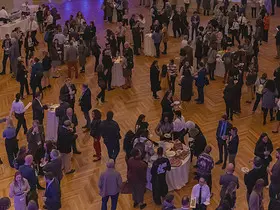
Linda Dishman, Executive Director of the LAC, opened the event with a warm welcome to the nearly 200 people in attendance. “We must face head-on the technical and philosophical issues of preserving modern resources,” she began, adding that “we need to start talking now about saving these structures, before it’s too late.” Dishman outlined the importance of the fifty-year mark for significant structures, an event to be commemorated and explored. “So here we are tonight,” Dishman continued, “at the beginning of a ‘magical history tour’ through one of the most important eras in the growth of Los Angeles.” She concluded with the hope that “tonight’s discussion will provide insight and guidance to our future advocacy efforts.”
The panel of five experts represented the fields of architecture, historic preservation, history and advocacy. Alan Hess (architect, architecture critic and historian) presented a well-received overview of 1960s building design in the Los Angeles area after Dishman’s introductions. Joining him on the panel were Chris Nichols (Associate Editor, Los Angeles magazine), David C. Martin, FAIA (Design Principal and Co-Chairman, AC Martin Partners, Inc.), Leo Marmol, FAIA (Managing Principal, Marmol Radziner and Associates), and Christine Madrid French (Director, Modernism + Recent Past Program, NTHP).
Moderator Frances Anderton (Host of DnA: Design & Architecture on KCRW) posed a number of compelling questions that framed how preservationists and architects seek to protect 1960s built resources, such as working with newer materials, adapting car-oriented design to pedestrian ideals, and enhancing sustainability. Audience members also queried the panel, asking about current concerns (how to incorporate public advocacy into larger efforts) as well as overall issues (the number of resources demolished over the last few decades). The entire session was videotaped by two cameramen and photographed for further distribution.
During the reception afterward, guests enjoyed desserts, coffee, and tea while networking with like-minded people. Friends of preservation came from the far reaches of the Los Angeles area, including author Robert Imber of Palm Springs (founder of PSModern tours), and Raymond and Dion Neutra (the two sons of architect Richard Neutra).
Day Two
The second part of the Modern Module followed up on and expanded upon the discussion initiated by the panel the previous evening. Invited guests at the roundtable included twenty scholars, city officials, preservationists, architects, and historians, as well as twelve students of Dr. Lauren Bricker from California State Polytechnic University, Pomona (Cal Poly Pomona).
As preparation, participants were provided with a copy of an article by noted historian Dr. Richard Longstreth, published in the NTHP Forum, entitled “I Can’t See It, I Don’t Understand It, and It Doesn’t Look Old to Me,” in which he detailed a number of critical concerns – and the ongoing debate -- surrounding the historic preservation of recent past architecture.
Dr. Anthea Hartig, Director of the Western Office for the NTHP, welcomed all participants and energetically facilitated the four-hour long meeting. She skillfully guided the participants through the ambitious agenda, separated into four parts: Introduction of Issues, Brainstorming (focus on generating new ideas and approaches), Prioritization (which ideas and solutions are most important), and Action (commitments and next steps).
Janet Hansen, Deputy Director of the Office of Historic Resources for the City of Los Angeles, provided a contextual overview of SurveyLA, the first comprehensive program to identify and document historic resources representing significant themes in the city's history. While Los Angeles has over 900 Historic-Cultural Monuments (local landmarks) and 24 Historic Preservation Overlay Zones (Historic Districts), to date only 15% of the city has been surveyed.
During the discussion, participants forwarded a number of practical next steps for protecting modern and recent past architecture:
-
Incorporate standards for historic preservation into the testing and licensing process for architects;
-
Address LEED evaluation systems to acknowledge the material nature of 1960s buildings;
-
Institute a curriculum of study at architecture schools that address preservation concerns;
-
Engage in more training for State Historic Preservation Office staff regarding local issues and contexts of significance;
-
Include real estate professionals in our public outreach programs;
-
Promote current, and develop new, incentives for homeowners who demonstrate good stewardship;
-
Update state historic building codes;
-
Tailor our approach to address the stories that resonate with the community;
-
Prepare a series of targeted nominations to local, state, and national historic registers as a way to engage the public and create a baseline for further research and documentation.
The entire session was recorded by digital audio for documentation purposes.
John Lesak, architect at Page and Turnbull and participant, has since proposed a follow up roundtable focusing solely on questions of materials (“green codes” for cities that incorporate performance-based language specific to modern historic resources, preservation briefs, updating of the Secretary of the Interior's Standards for the Treatment of Historic Properties to accommodate plastic and composites), at the Association for Preservation Technology annual conference to be held in Los Angeles in early November.
Oral Interviews & Film Production
The entire proceedings of the evening panel event were recorded on tape by filmmaker Jeff Krulik, in order to document and distribute this information to a wider audience. Chris Madrid French and Krulik also scheduled a number of on-site visits as part of a series of video vignettes intended for internet publication. Krulik, based in Washington, D.C., has produced and filmed documentaries for over twenty years and maintains a keen interest in the stories of the people who interact with, live in, and save historic structures.
Clifton’s Cafeteria on Broadway: A Los Angeles landmark since 1931, Clifton’s is the oldest surviving cafeteria-style restaurant in downtown. The interior design is crafted after a lodge in the redwood forests of the Santa Cruz Mountains. It also served as the weekly meeting place for the Los Angeles Science Fiction Society (attended by Ray Bradbury). The owners have maintained a long-term policy of giving a free meal to anyone who asks for it, continued to this day as a community service. Interview with owner Robert Clinton.
VDL II Research House: Richard Neutra Home and Studio, Silver Lake neighborhood. Krulik traveled to the nearby community of Silver Lake to meet with Dr. Raymond Neutra and architect Dion Neutra (sons of architect Richard Neutra) at their family homestead. Site director Sarah Lorenzen, AIA, also participated in this recording of the house, its history, and the current state of deterioration. The house, designed in 1932 and rebuilt in 1966 after a catastrophic fire, features a number of environmentally-friendly design features and promoted healthful living with nature. Hundreds of projects on four continents were designed there; Neutra worked from his bed in the house towards the end of his life. VDL played host to Frank Lloyd Wright, Lazlo Moholy Nagy, Charles and Ray Eames, Dr. Robert Schuller, John Anson Ford, and Vice President Hubert Humphrey. There is an ongoing effort to repair the roof-top water features and address major maintenance issues. Dionne Neutra deeded the house to Cal Poly Pomona by to be used by the university's College of Environmental Design faculty and students.
Ray Bradbury: French arranged an interview with Bradbury after reading coverage of his 89th birthday (held at Clifton’s Cafeteria) in the LA Times. In an hour-long meeting, Bradbury eloquently detailed his relationship with the Neutra family, his ideas for reviving Broadway in downtown LA and reinvigorating the Latino history of the street, the significance of Disneyland and the Monorail, and the importance of preserving libraries. He has also consulted on a number of architectural projects, including the US Pavilion at the 1964 World’s Fair. Bradbury is a world-renowned author, who has received the National Book Foundation's 2000 Medal for Distinguished Contribution to American Letters and the National Medal of Arts in 2004.
The Broiler, Firestone Boulevard, Downey, California: Krulik and French traveled to Downey, an outer suburb of Los Angeles, also known as one of the birthplaces of US car-oriented culture. Downey is home to the world’s oldest McDonald’s (1953) and the first Taco Bell (1962). The filmmakers focused on the recently restored Bob’s Big Boy. Erected on the site of a chicken-farm in 1958, the broiler/coffee shop (also known as Harvey’s and Johnie’s) was once chronicled by writer Tom Wolfe, and counted more than 5000 cars each weekend night at the peak of cruising-culture in the mid-1960s. The building was at the center of an extremely difficult preservation effort after its “final” closing in 2001. In 2007, the broiler was partially demolished without a permit. Adriene Biondo, of the Modern Committee of the LAC, spearheaded an unprecedented effort aimed at rebuilding the structure. With the support of the City of Downey mayor and council, Bob’s Big Boy agreed to rebuild the diner and is now nearing completion of the renovated/restored restaurant. The structure is a successful example of preservationists working with city officials and commercial interests to revive an historic structure. Interviews held on-site with Biondo and owner Jim Louder (who also owns a Bob's in nearby Torrance).