Twin Cities Modern Module
Challenges & Opportunities for Preserving Mid-Century Minnesota Architecture
October 27 and 28, 2009
New! Minnesota Modern: Era of Innovation, companion publication to the Minnesota Modern Module is now available in PDF format. To order free, printed copies, please contact Trustmodern at trustmodern@nthp.org.
New! Minnesota Modern Module companion video now available for viewing.
The National Trust for Historic Preservation (NTHP), with the cooperation and support of the Preservation Alliance of Minnesota, Preserve Minneapolis, DOCOMOMO MN, and the Minnesota Historical Society, hosted a two-day Modern Module in Minneapolis and St. Paul on October 27 and October 28, 2009. The event was funded by grants from the National Endowment for the Arts and the Henry Luce Foundation.
Day One
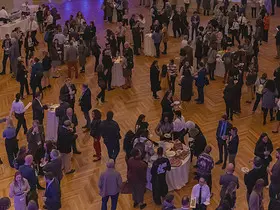
The Module began with a free, open to the public, panel discussion on the evening of October 27 at the Christ Church Lutheran, designated a National Historic Landmark (NHL) in January 2009. Architect Eliel Saarinen designed the sanctuary of the church in 1949, which further benefitted from an addition of an education wing designed by his son Eero Saarinen in 1962.
Preservation Alliance of Minnesota (PAM) Executive Director Bonnie McDonald and NTHP Advisor from Minnesota, Will Stark, Friends of Christ Church Lutheran, opened the evening with warm welcomes to the audience, numbering nearly 150, and shared background on the extraordinary community partnership that cares for the Church and worked towards its NHL designation. Pastor Kristine Carlson then shared a brief history of the church campus and their efforts to respect, preserve, and use these elegantly utilitarian spaces.
Following Pastor Carlson, David J. Brown, Executive Vice President of the National Trust provided an overview of the NTHP’s new Modernism+Recent Past Program, TrustModern. He noted how it builds on nearly two decades of work with partners like these in Minnesota and links the NTHP’s advocacy work with colleagues at the Trust’s iconic Modernist Sites, which range from Frank Lloyd Wright’s Pope Leighey House in Virginia to the iconic Philip Johnson Glass House in Connecticut. Brown noted that with the hiring Director Chris Madrid French this past March to work across the nation from our Western Office and the formation of a formed a 30+-strong team of colleagues from across the Trust, work has begun in earnest to enact TrustModern’s five core goals of creating a national, strategic agenda and network, provide high-quality programming like this Modern Module, create and implement a comprehensive communications strategy so that together we can raise public awareness and galvanize support; engage and enable citizens and organizations to advocate for 20th-century heritage and to and align this advocacy and these places with our and the world's Sustainability efforts. Brown noted that the NTHP’s Associate Director of the Sustainability Program, Patrice Frey, was in the Twin Cities for the Module.
Todd Grover (Partner at MacDonald and Mack Architects) began the formal program with a virtual version of his popular walking tour “Gateway to Greenway: Modernism in Minneapolis.” The tour, developed with Elizabeth Gales (an historian with Hess Roise), features a number of notable architectural monuments – both landscapes and buildings – that collectively illustrate the story of the city’s struggle to reinvent itself during the mid-twentieth century. Grover also reviewed the long term campaigns of preservationists to raise public awareness for architecture of this era, from the nascent stages of the movement to the recently truncated effort to designate a set of downtown structures as an “urban renewal” historic district.
With these images of the city fresh in the minds of the audience, moderator Dr. Victoria Young (Director of Graduate Studies for the Master of Arts in Art History program at the University of St. Thomas), introduced the full panel of experts, representing the fields of architecture, landscape architecture, and historic preservation. Christine Madrid French, Director of the Modernism + Recent Past Program, was joined by Todd Grover, Charlene Roise (President of Hess Roise historical consultants), Stephanie Atwood (historian), Jean Garbarini (Senior Associate, CLOSE Landscape Architecture+), and Ken Greishaber (landscape architect).
During the 90-minute panel discussion, Dr. Young posed a number of compelling questions that framed how preservationists and architects seek to protect built resources of the twentieth century, such as the relevance of original materials in the context of modern resource preservation and specific issues involved in the sustained use of aging urban landscape designs. The audience, in turn, queried the panel about regional topics of interest, including the significance of parking lots as character defining features of early shopping centers (the first indoor mall in the U.S. was built in the Twin Cities area). The entire session was videotaped by two cameramen and photographed for further distribution. A reception in the Education Wing followed the event, featuring handmade chocolates and savory snacks made by local caterers.
Day Two
The second part of the Modern Module expanded upon the discussion initiated by the panel the previous evening. Twenty-four invited guests joined the roundtable, including representatives from the State Historic Preservation Office, local preservation organizations, architectural firms, and universities.
As preparation, participants were provided with a copy of an article by noted historian Dr. Richard Longstreth, published in the NTHP Forum, entitled “I Can’t See It, I Don’t Understand It, and It Doesn’t Look Old to Me,” in which he detailed a number of critical concerns – and the ongoing debate -- surrounding the historic preservation of recent past architecture.
Dr. Anthea Hartig, Director of the Western Office for the NTHP, welcomed all participants and skillfully facilitated the meeting, held at the Minnesota Historical Society. The four part agenda included: Introduction of Issues, Brainstorming (focus on generating new ideas and approaches), Prioritization (which ideas and solutions are most important), and Action (commitments and next steps).
Bonnie McDonald, president of the Preservation Alliance of Minnesota, noted the long-term impact of the University of Minnesota Design School and its legacy of architecture across the state. A history of regional modernism developed under leaders at the school, including Ralph Rapson and Leonard Parker. Greater Minnesota is also remarkable for its proliferation of large-scale civic projects and a number of corporate modern campuses, such as General Mills.
Todd Grover noted that there are currently efforts in development to record the oral histories of “living modernists” from the twentieth century under the Minnesota chapter of the Society of Architectural Historians (MNSAH), but definitive funding sources must be identified before that work can be completed.
During the discussion, participants forwarded a number of ideas, practical next steps, and historical contexts specific to their region:
- Accurate survey materials, as guides for determinations of significance, are not available for design and architecture of this time period. More surveys must be undertaken to create baseline data.
- The changing character of suburban neighborhoods is becoming an issue in terms of teardowns. Residential areas created at mid-century as oases from commercial development now need to balance the tax base with shops, stores, and offices.
- The Skyways of Minneapolis have created a unique “second floor” historic context. Developed to protect pedestrians from the extreme weather of this region, there are now numerous elevated walkways between downtown buildings. These designs altered the way that people interacted with the structures.
- Urban renewal had a significant impact on downtown. Now that the designs of that era are also reaching an historic age, how do preservationists and historians interpret their context?
- How to address “mid-level fabric,” defined as churches, schools, libraries, and apartment buildings developed as infill in the 1960s, within the historic context of the area?
- Threats to the designs of this era include: “mega-fication” (constant need to expand building area), maintenance of precision engineering, changing expectations of tourists, accessibility, lack of scholarship to prove exceptional significance (under current National Register of Historic Places 50-year guideline for listing), and energy performance.
- Preservation suffers from the difficulty of selling “non-consumption” to the public. Must rely on sustainability arguments and re-use to save historic structures. Monetary incentives needed to inspire owners to preserve rather than demolish and rebuild.
- Historic preservation of this era must be integrated into government and planning to succeed on a large scale and to accommodate the number of subject buildings. Relating this effort to job development may advance the causes of preservation more readily at civic and state levels.
- Engagement with the public must rely on a determination of the audience, translation of information to specific buildings types of this era, a network of online tools, and a coordinated message between organizations.
Oral Interviews and Film Production
In order to document and distribute this information to a wider audience filmmaker Jeff Krulik and another cameraman captured the entire proceedings of the evening panel. Chris Madrid French and Krulik also scheduled a number of on-site visits as part of a series of video vignettes intended for internet publication. Krulik, based in Washington, D.C., has produced and filmed documentaries for over twenty years and maintains a keen interest in the stories of the people who interact with, live in, and save historic structures. In the greater Twin Cities area, the team visited an important range of places and people.
St. John’s Abbey, Collegeville, 1953-1961. At Marcel Breuer’s daring Abbey, Krulik and French interview Father Hilary Thimmesch and Brother Alan Reed. Beginning in 1953, Breuer and the Benedictine brothers embarked on ambitious redesign of the Abbey campus in highly symbolic and bold forms, stunning use of color, and revolutionary use of cast concrete. Uses of the site under Breuer’s master plan delineated the monastic living quarters and the educational buildings by connecting them to the shared spaces of the church, auditorium, library, and administration building. It is the church building and its bell tower, called a bell banner, which is by far and by design the standout.
Cedar Square West, Minneapolis, 1973. Designed by noted architect Ralph Rapson, the series of six towers rose with federal support under the “New Town in Town” program. The ambitious redevelopment plan originally called for housing 30,000 people in the Cedar-Riverside neighborhood, but only a portion of the scheme was completed. Also known as Riverside Plaza, the multi-height and multi-hued concrete towers (each decorated with colorful metal panels) contain more than 1300 residential units, one half of which are reserved for subsidized housing. The 39-story McKnight Building is the tallest structure outside of downtown and now stands at the center of a newly developing community of Northeastern African immigrants, arriving primarily from Somalia.
Richfield, Minnesota. Interview with Joe Hoover, president of the Richfield Historical Society. Richfield began as one of the earliest settled farming communities in Minnesota in the 1850s, but reached its full potential as an early suburb of Minneapolis, populated by returning World War II veterans nearly 100 years later. Nearly 14,000 people moved to the formerly agricultural area between 1940 and 1950, and in 1954 Richfield received the All American City award from the National Municipal League and Look Magazine. The seven-square mile area now contains 10,000 homes and 5,000 apartments. In 2005, the community opened its own History Center and archives to highlight the century of development in Richfield.
Leonard S. Parker, FAIA. Born in Milwaukee, Wisconsin, Parker developed his own distinctive approach to modern design under mentors Ralph Rapson (at MIT) and Eero Saarinen (with Saarinen and Associates in Michigan). In 1958, Parker started his own firm with $8000 borrowed from a relative and embarked on a long and productive career in architecture. His completed works include the U.S. Embassy in Santiago, Chile, ca. 1985, and the Minnesota Judicial Center on the Minnesota State Capitol Grounds. He won the American Institute of Architects Gold Medal in 1986, in addition to more than 120 regional, national, and international awards. Parker taught architecture at the University of Minnesota for 34 years and also served as president of AIA Minnesota and the Minnesota Architectural Foundation. Interview coordinated by Judy Grundstrom, architect.
Conclusion
The NTHP through the Twin Cities Modern Module programming and activities provided numerous engagement, education, and outreach opportunities. It was well-received and embraced, which will facilitate successful follow-up and achievement of the program’s goals of coalescing and building a national network that will collectively identify and save more places of the United State’s modernist and recent heritage.