Wright Where You’d Least Expect It

In a remarkable effort, an Alabama city purchased, restored, and preserved a dilapidated Frank Lloyd Wright house, then opened it to the public.

Wright
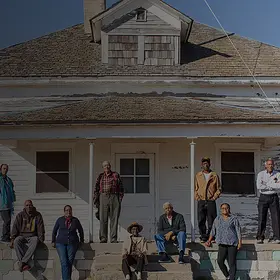
The Rosenbaum House today, and as it appeared in 1948. Wright completed his design for the house just months after this portrait was taken.

Credit: Patrick Hood

If you spend any time in Florence, Ala., you know the Rosenbaum House. With those dark walls and flat roofs, it just looks different from the other houses in town—and always has. "It's our conversation piece," says local resident Betty Burdine, who has lived here for 50 years. "At some point, everybody's gone by and stared at it. But until a few years ago I can't remember anyone mentioning Frank Lloyd Wright."

Come again? Yes, Frank Lloyd Wright. The same architect who added "Prairie Style" and "Fallingwater" to the American lexicon designed the eye-catching anomaly on Florence's Riverview Drive. He couldn't have imagined that residents who shook their heads over his radical style would eventually rescue the house from ruin and declare it a town treasure.

Quite a feat for a city that prizes modesty over modernity.

Wright's Florence connection began when local boy Stanley Rosenbaum married Mildred Bookholtz in 1938, and brought her home to Alabama. Stanley had his eye on a sloping corner lot directly across the street from the traditional house where he grew up, and his parents obliged, offering the property as a wedding gift. The newlyweds would stay in the neighborhood, but "fitting in" wasn't part of their plan.

A friend recommended that the Rosenbaums approach Frank Lloyd Wright, reputed to be a seasoned and affordable architect. Optimistically, the Rosenbaums asked Wright to design a three-bedroom house with two baths, a study, and a living room large enough for a piano—all for $7,500.

Wright responded with plans for what he termed a "Usonian" house: an affordable family residence blending traditional building materials with new and inexpensive products such as concrete block and plywood. And within a year the house was finished, but at a cost of more than $14,000— nearly double the original estimate.

With its earthy blend of red brick and richly stained cypress, the 1,540-square-foot house proved a sensation in Florence. Hundreds of residents drove by on weekends to gaze at the structure. Barbara Kimberlin Broach, director of Florence's Arts & Museums, says that "one visitor stared at Stanley Rosenbaum's house for a long time, then asked, 'What is it?' " The Rosenbaums didn't seem to care.

Remarkably—despite cost overruns, local ribbing, and never-ending problems with both the dead-flat roof and the in-floor heating system—the Rosenbaums adored Wright and his design. "Our enthusiasm ... has not abated one whit," Stanley wrote. They even returned to him five years later to request an addition. Stanley Rosenbaum lived in the house until his death in 1983, and Mildred stayed until 1999, when she moved into a local retirement facility.

By then, says local architect Donald Lambert (whose firm worked on the restoration), the house was in terrible shape. "Someone from the building department practically certified that the house was in danger," he remembers. "There were buckets all around to catch rainwater. A part of the roof in the addition was covered with plastic sheeting, and we knew there was a threat of collapse." Still, Lambert felt determined to save the house, because it was architecturally significant, and because it was "good for Florence."

"I was friendly with Mayor Eddie Frost and lobbied him to buy this house," Lambert remembers. The argument was straightforward: "If you're going to invest in something that the city will own, let's invest in something with national or international significance, like a property designed by Frank Lloyd Wright." Frost and the city council agreed, and used $75,000 in public funds to purchase the house from Mildred Rosenbaum.

"This was a great preservation effort not just by an individual, but by 39,000 people," says Barbara Broach. "With money generated by a one-cent sales tax for community development, we made sure that everyone here had a stake in the preservation of this house."

That's when the process of restoration and reconstruction began in earnest.

"We took this thing apart piece by piece," Lambert says. Priority Number One involved repairing the roof. Wright's design had called for a sloping surface, but the construction crew built a flat roof instead, causing extensive problems with leaks and mold. "We started by peeling it off," Lambert says, "and by the time we were finished we'd had to take off every stick of old wood."

Contractors then began the arduous process of replacing everything overhead. Where required, they introduced steel plates between pieces of wood for extra stability. (Wright had used steel in portions of the original house, so Lambert felt comfortable introducing the material.) Like the original roofers, they followed an intricate plan for roof joists. But unlike their Depression-era predecessors, they gave the finished roof the subtle slope that Wright had called for. For the first time in half a century it ­didn't leak.

Controlling heat and humidity in the house posed the second grand challenge. Wright had designed an in-floor heating system, but (as with so many of his innovative solutions) it failed after a few years. The Rosenbaums resorted to a motley collection of space heaters.

Conditions seemed even worse during Alabama's hot and humid summers, when temperatures in the house skyrocketed. Though the Rosenbaums experimented with rooftop and other makeshift air-conditioners, the units functioned poorly and condensation wreaked havoc with woodwork throughout the interiors.

Lambert opted to install completely new heating and cooling systems: two hidden behind a parapet atop the roof to preserve the home's simple lines, one placed inside a bedroom closet, and one outside the master bedroom. "We left the original pumps and the original water heater in place so that visitors could understand how the in-floor system once worked," Lambert says. "But restoring those would have required jackhammering the concrete floor, repiping, and repouring it all. We couldn't justify that cost."

A final surprise awaited construction crews examining the walls in Mr. Rosenbaum's tiny study. Termites had not touched the horizontal cypress boards there—"apparently they didn't taste very good," Lambert says—but the pests devoured the pine sheathing behind the cypress, as well as a collection of books on the study shelves.  When workers opened book covers, half-eaten pages cascaded onto the floor.

To save the study, craftsmen inserted new sheathing and reinstalled the cypress planks, which were then sanded along with all of the interior and exterior cypress in the house. That entire process took months.

With restoration work complete, Barbara Broach and other volunteers returned the Rosenbaums' original Wright-designed furnishings to the house. Chairs in the dining room were the only pieces that had to be reproduced for the preservation effort. The originals were so uncomfortable, Broach says, "that Mrs. Rosenbaum gave them to the maid." She then bought the family a set of Eames chairs that stayed here for years. "Though those looked fine, we wanted to show the interiors as they appeared when the house was completed, so we used wood salvaged during the restoration and had a carpenter remake Wright's originals." 

Finally, after spending nearly three years and more than $700,000 on the project, the City of Florence opened the house to the public, inviting every resident to walk through. "They had a huge stake in this," Barbara Broach says, "and they lined up all day long for three days." More than 4,000 visitors came through exactly 62 years after the Rosenbaums had moved in. Today, approximately 5,000 visitors take guided tours of the house each year.

Florence has received numerous accolades since the restoration. The Alabama Architectural Foundation offered a prized Significant Building Award in 2002, and the Frank Lloyd Wright Building Conservancy followed with its 2004 Wright Spirit Award.

"At first," Broach says, "whenever people visited I'd nervously call Don Lambert and say, 'We'll be taking another test with visitors here tomorrow … I just thought I'd let you know.' But time after time I'd watch them admire all we'd accomplished. Now I just relax and enjoy sharing this remarkable house."  

Comments

Nickname
Comment
Enter this word: Change


Submitted by visitor54 at: September 2, 2008
I just visited Florence specifically to see the Rosenbaum house. It is truly a treasure. I am sorry that Alvin Rosenbaum is so bitter. His childhood home has been restored for all to enjoy. Thank you, City of Florence.

Submitted by Alvin Rosenbaum at: July 11, 2008
Nothing Mr. Lambert says contradicts my comments. The problem is that the Florence, Alabama official quoted in the story failed to acknowledge the key role my mother played in preparing for the restoration of the house and arranging its donation to the city. My mother was a faithful steward of the house and lived in her Frank Lloyd Wright residence longer than any other Wright client. I regret that her unique contributions are overlooked by city employees who continue to claim all the credit for preserving the house.

Submitted by Don Lambert at: June 29, 2008
As the architect for the restoration, I am compelled to respond Mr. Alvin Rosenbaum's attempt in these comments to discredit the efforts of the City of Florence, Barbara Broach, the City's museum director, and myself. The restoration process spanned 3 years and included countless hours of work that became a "labor of love" for members of the team involved in the restoration. Contrary to Alvin Rosenbaum's assertion, John Eifler was invited by the City to visit the house for a one day consultation so that we could glean from his valuable experience with other Wright houses. He furnished a written report of recommendations, mostly on materials that he had successfully used on other Wright houses in the past. Our firm relied on original drawings, specifications and photographs obtained from the Frank Lloyd Wright Foundation in Scottsdale, Arizona to complete the restoration. Mrs. Rosenbaum was consulted several times during the process and seemed to be genuinely thrilled on her visits to the home after the restoration was completed. Alvin Rosenbaum's reference to the book co-authored by Milton Bagby, Barbara Broach and me was anything but "full of self-aggrandizing errors". It is a book that describes the process that was required to restore a once grand treasure that had fallen into disrepair through no fault of Mrs. Rosenbaum who was in her late 80's and unable to maintain the structure as needed for the last 10 years of her life. I am so sorry that Alvin Rosenbaum cannot enjoy or appreciate the sacrifice the City of Florence has made to preserve this historic treasure, his childhood home. I do take comfort in knowing that his mother was very appreciative of the sacrifices of the many people who made it possible for her to see her home preserved for others to enjoy for many years to come.

Submitted by eileenkny at: June 29, 2008
Kudos to Florence!! Our past is worth preserving, and it's wonderful to see a town determined to do just that. More places across the country should take notice and do the same thing with historic structures; not just destroy them in the name of progress.

Submitted by studearch at: June 26, 2008
I visited the house as a recent graduate from architecture school with my boss while on a project in Florence about 1975 on a brutally humid, hot summer day. We caught Mr. Rosenbaum coming home for lunch and, although he was in a hurry and denied our request to look inside, he graciously offered a quick walk around the exterior. I remember him standing in the shade of the outrageously cantilevered carport roof, describing the experience of working with Wright and living in his iconic house, frequetly visited by architects like us. I also remember after he turned to go inside for his lunch, grabbing the end of the roof cantilever, only about 6'-8" high, and seeing if it would deflect under my weight.It visably moved and made popping noises in spite of the steel plate reinforcement to the wood structure. My conservative boss suggested that we depart before we cause a calamity and offered that he would never design such a daring cantilever in these litigious times, so we returned to our practice designing peusdo-southern Colonial houses (yeuch!) However, I will always remember that Mr. Rosenbaum spoke with great admiration and inspiration of living in the house, which appeared in perfect maintenance on the exterior. Sargeant's book on Usonian houses mentions that books braced the horizontal shelves which in turn braced the plywood walls, which maight explain the deterioration and wall damage. I look forward to someday visiting the house again and satifying my curiousity about the interior. Kudos to the city for recognizing this architectural gem. Jack Logan, architect, Albuquerque, NM

Submitted by Alvin Rosenbaum at: June 23, 2008
I might point out that my mother, Mildred Rosenbaum, and the National Trust for Historic Preservation had a significant role in the preservation of the Rosenbaum house for more than a decade leading up to the City of Florence assuming stewardship. The house was entered onto the Historic Register in 1978 and my mother, with the help of the National Trust, formed the Frank Lloyd Wright Rosenbaum House Foundation in 1990. I wrote a book about the Rosenbaum house, Usonia: Frank Lloyd Wright's Design for America, that was published by The Preservation Press of the National Trust in 1993 and Alabama Public Television produced a documentary broadcast and video, Rosenbaum House: Wright in Alabama, in 1995. Mrs. Rosenbaum hosted more than 5,000 visitors through the house before donating the house to the City in 1999. The $75,000 payment was for the value of the furniture and an appraiser referred by the Frank Lloyd Wright Building Conservancy appraised the property at $375,000 without its contents. Mrs. Broach had nothing to do with any of this until after the restoration was completed and has written a book full of self-aggrandizing errors. Mrs. Rosenbaum was the first recipient of the Wright Spirits Award from the Frank Lloyd Wright Building Conservancy. John Eifler, FAIA, Chicago, who had restored the Jacobs house in Madison< Wisconsin, developed the restoration plan for the Rosenbaum House that was implemented by Craig Construction Company and a local architecture firm.

Submitted by Dr Phil at: June 22, 2008
I lived right down the street from this house for many years and my parents still do. I never knew much about it growing up other than playing on top of the storage shed next to it. I finally figured out what a treasure it was and Mrs Rosenbaum took me (and friends) on a couple of fantastic tours while she was still alive and living there.

Submitted by morgan at: June 19, 2008
I grew up in Florence and my family always knew the house was special. I don't know any one who felt different! While I haven't lived there for almost 30 years, I did return home for a tour of the home with Mrs Rosenbaum. I also took poetry under her husband at the University of North Alabama


Powered by Convio