Name Dropping

As local stores disappear, so does homegrown flavor

Rich's
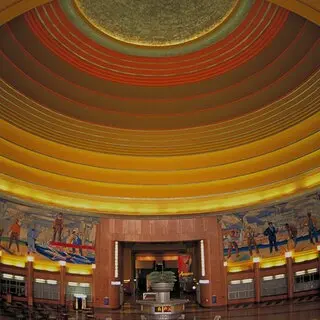
Rich’s department store in Atlanta, now part of the Sam Nunn Atlanta Federal Center

Credit: Library of Congress

When I was a kid in Plainview, Tex., my retail world encompassed just four local establishments. One was the grocery store my Uncle Bryan owned, where I was allowed the occasional free candy bar and thereby became the envy of all my friends. Another was the drugstore with a soda fountain where we sat on spinning stools and gulped root beer floats until dizziness showed us the error of our ways. Then there was Anthony's, a department store both depressing (it was where we shopped for back-to-school clothes) and fascinating (it had a system of pneumatic tubes that sucked up little containers with a loud thoop! and sent them flying off to who-knew-where). And there was Woolworth's, which for some reason was known in my family as "Woolsworth," and which sold just about everything a kid could want.

Bryan's Food, West's Pharmacy, Anthony's, Woolsworth. They all seemed utterly permanent, but they're gone. Not the buildings, you understand—the last time I visited my childhood hometown, the buildings I remembered were still standing. It's the names that have vanished.

Now that I think about it, the course of my entire life can be traced through the names of businesses that no longer exist. As a teenage would-be fashion plate in Lubbock, I bought my penny loafers and button-downs at Dunlap's or Hemphill-Wells. Later, when I lived in Richmond, Va., I could choose between Thalhimer's and Miller & Rhoads, giant emporia that loomed across the street from each other—or visit the hushed confines of the Berry-Burk men's store, whose entrance was crowned with the carved stone image of a dandy in a top hat.

Gone now, every last one of them, gone the way of Woodward & Lothrop and Strawbridge & Clothier, I. Magnin and B. Altman, Marshall Field's and Rich's, and scores of others. Once in a while, their names show up in florid script on boxes or shopping bags found in the back of a closet, and you can sometimes spot their dimly remembered logos carved above doorways or painted on the sides of buildings. But if you actually walk inside one of these erstwhile mercantile palazzos, don't expect to be greeted by solicitous salesclerks proffering neckties and foundation garments: The old Miller & Rhoads flagship store is a hotel now, and the Berry-Burk building houses upscale apartments. At least those stores fared better than Thalhimer's—partly torn down a few years ago to make way for a new performing arts center.

Well, sic transit gloria mundi, and what difference does it make? Actually, a pretty big one. As distinctive local brands disappear, everyplace gradually turns into anyplace. From Maine to Arizona, we all shop at the same stores and eat at the same ubiquitous (hmmm, rhymes with iniquitous) restaurants, and the whole country is becoming as thoroughly homogenized as a quart of milk. Goodbye Hi-D-Ho, where carhops delivered Hidy Fries; hello McDonald's, where machines extrude Whateverburgers.

What can we do? It's pretty simple: We can't resurrect all the long-gone institutions we once knew, but we can certainly cherish the ones that are left. Heeding the familiar admonition to "buy local" is good for the soul as well as the economy.

A recent book called Whatever Happened to Tanganyika? is all about "place names that history left behind"—like Batavia and British Honduras and the Gilbert Islands (now rechristened Jakarta, Belize, and the Republic of Kiribati, in case you haven't been keeping up). Admittedly, changing the name of an entire city or country is a much bigger deal than the disappearance of a single store—but the way I see it, a loss is a loss is a loss. And they have a way of adding up.  

Like what you see? Subscribe to Preservation and explore the mystery and meaning of our most beloved places through in-depth features and vibrant photography.


Comments

Nickname
Comment
Enter this word: Change


Submitted by johnevans at: February 16, 2010
Thahnk you for mentioning my hometown's(Iva,S.C.) loss of our 1906 corner drugstore. Just as you pointed out, Mr. Young, it's counyterproductive to cry over spilled milk---so, I am trying to get historic districts designated in this little hamlet. Brother, the requirements are difficult for small town America---zoning boards, etc. esp. if you have a mayor that has been weened on the reckless theme of antidisestablishmentarianism. That drugstore was an icon for this area in southern Anderson County, S. C.. My dad should never have sold it to the present owner, who promised he would haVE IT RESTORED---six months after dad's death he built a new building wwedged in between the 1906 and the 1961 site. Of course the first thing to come down was a magnolia tree my gr. gr. aunt, Iva Cook Bryson, had planted in her father's side yard in 1890--I knew then it was going to be trouble all the way. John Evans, Iva, S. C.

Submitted by Cass at: December 9, 2009
Well, gee, now I'm all nostalgic for Gimbels, gone for years, and Fortunoff's, a recent NY-area loss. Not to mention Abraham & Straus, Arnold Constable, Swezey's on Long Island ... too many lost! In our area of northern New Jersey, the mall thrives, and Main Street has too many empty storefronts; we are not alone in this. I've been looking into the 3/50 Project, which is easily found online -- it encourages people to revitalize their local downtowns by spending a total of at least fifty dollars a month at 3 local businesses -- not franchises, but true locally owned businesses. Sounds like a good beginning.

Submitted by john d evans at: November 23, 2009
If I didn't know better I would think that you grew up in my hometown, Iva, S.c. had the unpleasant experience to watch my families 1906 corner drugstore bldg demolished (my dad sold the business in 1997, that was ok---b ut he sold the remaining downtown corner lot to the new man and added a handshake promise that he would restore the old bldg---it was a classic 2 story, terracotta brick with white trim and boxing-- as soon as my father died in 2004, new man cut down the old magnolia tree behind the store, which my gr. gr. aunt, Iva cook bryson, planted in her dad's bavckyard--the house burned in 1895 and the drugstore was built in 1906) -----I nearly hafd a stroke upon hearing the handshake deal---and sure enough afater my group called Iva Historic Preservation fought fought for two years , the ole new man had it demolished---the photos are quite dramatic--I sent them to James Schjwartz--take a look at them and please urge him to publish one of the photos----I am trying to be a good loser, but pretending to be something I am not is the hardest thing I have ever done---I would like to say what Jewell Mayhew told Olivia deHaviland in Hush, Hush sweet charlotte---"if there is one thing I have hoped for it was that I would never see your face in this town again. We really lost a treasure. Well, those born afater 1967 have no idea what the bldg was all about. I reemember those suction tubes at Gallant-Belks in Anderson, S. C.----my brother remembers when it was a little box on a cable that travel;ed to the office. Do you remember x-raying your shoes to make sure they fit? Andersaon County, S. C. is a haven for the Young Family--in one family there were the following physicians--dr. c.h., dr. J. r., dr. anne, dr. mason, dr. e. reynolds, and dr jimmy---all youngs except dr. anne md. Dr. c.h.--they are all deceased and the families have scattered. They were all A> R> P>Associate reformed presbyterian, whose college, Erskine,is at due wqest, s.c. some 18 miles from Iva. They say of Due West that a rooster isn't allowed to crow on Sabbath. Keep writing---.John d evans

Submitted by Garry at: October 31, 2009
Liked this article. Took me back to the days when I loved browsing through Woolworths and sitting on a soda fountain stool sipping a root beer float. No one could make as good a one as Woolworths.

Submitted by shabo at: October 9, 2009
It's really sad that everyone buys the same and eats the same and thinks the same. When I go to wholesale merchandise shows I have to wonder where all the product for sale on display ends up. Not Wal-Mart, Penny's or Sears, but in the little shop on Main Street who has a wonderful variety of gifts and art and more- more than you'll ever find in the malls. And why aren't the buying public supporting these stores? Perceived lack of parking in the downtown? Laziness - it's to far to walk the 1/2 block to get to the store after I park. But they walk more than that to get to the door of the mall. Who really knows what excuse shoppers will use - they want what was, but don't participate to keep it from closing or disapearing.

Submitted by B. L. at: September 8, 2009
I appreciated Mr. Young's article about vanishing stores for 2 reasons. One, I too can remember the pneumatic tubes of our 2-story Penny's Dept. Store. And two, because Mr. Young suggests that we can attempt to maintain the small business owner by 'eating local'! Yes, hooray, I too feel this way. In fact I just recently published an Agri-Tourism guide to the Central South Coast of Calif. "Green Getaways". A beautiful and educational book on eating local, supporting the small farmer/ranchers and having fun at the same time. website: greengetawaysguide.com Yours, Mrs. B. L. Homsy


Powered by Convio
nonprofit software