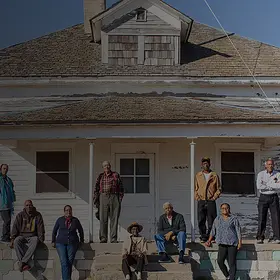
America's Eleven Most Endangered Historic Places
These remarkable sites could soon be lost—learn why they must be saved at once
By Sudip Bose | From Preservation | July/August 2010
Each year, the National Trust for Historic Preservation highlights threatened sites across the country that demand immediate attention. Not only does the 11 Most list emphasize the importance of preservation nationwide, it also helps local groups to rally support for the buildings, landmarks, neighborhoods, and historic landscapes in imminent danger.
Black Mountain Lynch and Benham, Ky.
"Bloody Harlan" was the chilling nickname once ascribed to rural Harlan County, a place beset by frontier violence and turbulent labor struggles in the past. Located in the Appalachian Mountains in eastern Kentucky, the county is home to the historic communities of Lynch and Benham (pop. 900 and 600, respectively), located at the base of Black Mountain. In recent years, these old coal company towns have been trying to reinvent themselves as tourist destinations, trading on their mining heritage while pursuing economic development based on clean-energy technologies and green jobs. (Some residents, for example, advocate placing wind turbines on Black Mountain, home to a biodiverse hardwood forest.) But coal companies, undeterred by the state's purchase of timber and mineral rights at the mountain's upper elevations, are seeking permits to strip, auger, and deep-mine at elevations below 3,200 feet. Mining would almost certainly lead to erosion, water pollution, and flooding—and endanger the vision of a new Harlan County, in which the local economy is increasingly driven by alternative energies and tourism.
Industrial Arts Building Lincoln, Neb.
It was once a star of the Nebraska State Fair: a massive building shaped like a trapezoid, with skylights and a fanciful arcade of steel arches. Designed by Omaha architect Burd F. Miller, this grand space opened in 1913, exhibiting agricultural, then industrial technologies. (It also served as a storehouse for surplus military aircraft; Charles Lindbergh learned to fly a plane that was housed in this very building.) But by the time the Nebraska State Fair left town last year, the Industrial Arts Building had suffered from years of neglect and deferred maintenance. One recent study estimated that rehabilitating the structure's shell would cost about $5 million. Demolition now seems probable; the new owner, the University of Nebraska, plans to construct a massive research facility, called the Nebraska Innovation Campus, on the site of the former fairground. In July, the university's board of regents will vote on whether to demolish Industrial Arts.
Saugatuck Dunes Saugatuck, Mich.
On Michigan's western coast, the Kalamazoo River empties into Lake Michigan amid a landscape of sublime natural beauty—sand dunes, woodlands, and wetlands that provide a habitat for diverse species of animals (some endangered), as well as a destination for vacationers escaping Chicago's sweltering summers. As beloved as the scenery are the region's historic buildings and cultural institutions, such as the Ox-Bow summer art school. In 2006, Singapore Dunes, LLC purchased the former Denison property, a roughly 420-acre parcel of coastal land, intending to develop it. Singapore Dunes has since sold 171 acres—the southern portion of the property—to the Land Conservancy of West Michigan and the City of Saugatuck. But preservationists fear that multimillion-dollar houses and a hotel-marina-restaurant complex might rise on the northern half. The future of the Saugatuck Dunes coastal area depends on whether federal courts uphold zoning laws prohibiting commercial development on the scale discussed.
America's State Parks and State-Owned Historic Sites
Across the nation, governors and state legislatures have slashed funding for state parks and historic sites. Recently, California proposed shuttering all of its state parks (150 have already experienced service reductions or partial closures). Now, proposed cuts or closures threaten parks in New York, Pennsylvania, Arizona, and New Jersey, among other places. In New York, the Office of Parks, Recreation and Historic Preservation has endured severe funding cuts and may have to shut down a large number of parks. In Pennsylvania, the Historical and Museum Commission, which oversees the state's historic sites, lost one- third of its budget in a single fiscal year. Closure or reductions in services could lead to vandalism and the deterioration of countless historic structures and landscapes—not to mention a loss of jobs and tourism dollars.
Threefoot Building Meridian, Miss.
Meridian, a city of about 40,000 once famed for railroading and manufacturing, might seem like an unlikely place for an Art Deco skyscraper. After all, this is Mississippi, a state awash in Colonial Revival and Beaux-Arts riches. But there it stands in the heart of downtown: the Threefoot Building—16 stories of brick and multicolored terra-cotta, completed in 1929, paid for by a prominent family of German American merchants, and designed by Mississippi architect C.H. Lindsley. Walk inside this office tower and you enter a richly decorated lobby, with marble floors and typical Deco flourishes. But though the building is unquestionably a masterwork, it has faced an uncertain future from the moment it arose during the depths of the Great Depression. About 20 percent of the building has always been vacant, and the tower now stands in a state of disrepair. Water has entered the structure, terra-cotta tiles have plummeted from the facade, and broken windows remain unrepaired. The city, which owns the Threefoot, does not have the money required to stabilize the building. Though developers from New Orleans recently wanted to renovate the skyscraper into a hotel, Meridian officials expressed concern when they learned that the city would have to finance part of the project. The only hope now is to persuade city officials to save the tower and allow a developer to rehabilitate it.
Juana Briones House Palo Alto, Calif.
She was many things: nurse, farmer, cattle rancher, businesswoman, healer. But perhaps most important of all, Juana Briones y Tapia de Miranda (1802-1889) was a landowner—a rare accomplishment in her day. In 1844, Briones set up a 4,400-acre ranch near present-day Palo Alto, retaining title to the property after the United States gained control of California in 1848. The core of this house (a rare example of regional vernacular architecture) was later subsumed by a residence dating to the 1900s, and it is this structure that now stands vacant and deteriorating. The owners of the house applied for a demolition permit in 1998, and in 2007, the City of Palo Alto finally issued the requested permit, though it failed to conduct an environmental review, thus triggering a lawsuit that is currently in the appellate courts. If the structure is razed, any opportunity to determine the extent of the house's 1844 components, and study their condition, will be lost.
Metropolitan African Methodist Episcopal Church Washington, D.C.
Officials of the A.M.E. denomination knew what they were doing in the 1880s when they sited this red-brick Victorian Gothic church (shown at left in the 1890s) close to the White House and Capitol. Here, in proximity to the corridors of national power, the children of congregants received an education and religious instruction, community members gathered to discuss important issues of the day, legendary figures such as Frederick Douglass and Rosa Parks were eulogized, and civil rights leaders organized their campaigns. Today, this so-called National Cathedral of African Methodism is in desperate need of repairs. Because of a failed internal guttering system, water is a major problem, having damaged the sanctuary and auditorium. The entire structure, which lacks adequate fire protection and updated electrical wiring, has been compromised, with the sanctuary's ceiling in particularly bad shape. To make matters worse, significant cracks threaten the facade—possibly the result of development that has boxed in the church on three sides over the course of the last 15 years. Stabilization would require $5 million, a complete restoration more than twice that.
Merritt Parkway Fairfield County, Conn.
Since its completion in 1940, the Merritt Parkway has provided a pastoral setting—a dense canopy of green—for a 37-mile drive through suburban Connecticut. In pleasing counterpoint to the landscape of indigenous trees and shrubs are bridges in various architectural styles—Art Deco, Gothic, French Renaissance, and Art Moderne. But times have changed since the 1940s, when much of Fairfield County was verdant farmland. Now it's the most populous county in the state, and up to 80,000 vehicles travel the route each day. Because of safety concerns, the parkway has, over time, been "modernized," though some preservationists contend that certain state projects—such as road realignment and interchange redesign—have not followed established guidelines. Furthermore, many of the bridges are in disrepair, with parapets crumbling, ironwork rusting, and pieces of concrete breaking off. With millions of dollars coming in via the American Recovery and Reinvestment Act, the state transportation department has embarked on a massive tree removal program that could undermine the aesthetic vision of the parkway's creators. Local preservationists argue that safety concerns can be addressed without compromising the essence of this historic road.
Wilderness Battlefield Orange and Spotsylvania counties, Va.
You might not know—if you happened upon this rural terrain in northeastern Virginia and gazed at the gentle lay of the land, the thickets of trees and blooming wildflowers—that one of the bloodiest battles of the Civil War took place here on two fateful days in May 1864. Nearly 30,000 men died or were wounded in what came to be known as the Battle of the Wilderness. But what will this landscape look like if Walmart succeeds in building a 140,000-square-foot store on the edge of the battlefield? The Friends of Wilderness Battlefield and local residents have brought a legal challenge contesting the Orange County board of supervisors' decision to allow construction. The issue here is sprawl: Many preservationists fear that still more development at the intersection of Routes 3 and 20 will be the catalyst for a strip-mall chain reaction, forever scarring large swaths of the open space where the course of the nation's history was altered.
Hinchliffe Stadium Paterson, N.J.
Hinchliffe Stadium's glory days—when the New York Black Yankees called the park home, when the likes of Larry Doby, Josh Gibson, and Oscar Charleston prowled the baseball diamond, shagging fly balls and slugging pitches clear of the fences—lie well in the past. Constructed in 1932 for up to 10,000 spectators, this concrete shrine of Negro League baseball slowly turned into a monumental eyesore. Vagrants, gangs, and drug users began lingering on the grounds, and some of the stadium's architectural elements were looted. Arsonists even destroyed a stadium bathroom. Paterson's public school district, which owns Hinchliffe, cannot afford to provide adequate maintenance. Good news might be on the way, however: In November, voters approved the allocation of up to $13 million for the stadium's restoration, though the city of Paterson has yet to release the funds.
Pågat Yigo, Guam
On the northern coast of Guam, ringed by sheer limestone cliffs, lie the remains of an ancient village of the Chamorro, the indigenous people of this island, which is now a U.S. territory. The archaeological riches at Pågat are significant: more than 50 mounds (or middens) containing evidence of day-to-day life and some 20 sets of lattes—limestone pillars, crowned by capstones, that once supported dwellings made of wood and thatch. To see all of this requires heroic stamina. A hike along the trail to Pågat cuts through dense jungle and makes a steep descent past a sinkhole cave filled with freshwater pools. Access to the site and the integrity of its archaeological resources may be threatened by the U.S. military's plans to relocate about 8,600 Marines and 9,000 dependants from Okinawa to Guam. The move will likely trigger a flurry of building activity, from new facilities to a firing range to a wharf that can accommodate a nuclear-powered aircraft carrier. The Guam Preservation Trust is hoping to work with the military to come up with a plan that will keep Pågat intact, while allowing the public continued access and archaeologists the chance to excavate.
For more photos, stories, and tips, subscribe to the print edition of Preservation magazine.
Comments


Submitted by Editor at: September 7, 2010
We published a story on the USS Olympia in June 2010; you can read it here: http://www.preservationnation.org/magazine/2010/todays-news/famous-ship-needs-rescue.html
Submitted by DCLawyer68 at: September 6, 2010
As someone who just renewed my membership, let me add my voice to those concerned about the USS Olympia. The situation sounds dire. The lack of anything on the Trust's website regarding the Olympia is disturbing.
Submitted by riverat at: August 3, 2010
two Places top my list the Wilderness battle field and the Industrial building at the old Nebraska State fair grounds.
Submitted by jerseyrefugee at: July 13, 2010
Re: USS Olympia (Philadelphia, PA) I was relieved to see that others share my concerns over the future of the USS Olympia (C-6). The Olympia is the oldest steel-hulled warship still afloat. It was from bridge on May 1st, 1898 during the Spanish-American War that Commodore George Dewey uttered the words "You may fire when you are ready Gridley", thus beginning the Battle of Manila Bay and announcing the emergence of the United States as a world power. In WWI she would serve as flagship of the Atlantic Squadron in 1921, she would carry the body of the Unknown Soldier of the First World War home from the battlefields of France. The cruiser Olympia was destined to be scrapped after WWII, but was saved in the 1950's thanks to the efforts of America's school children who donated their pennies to the effort. The USS Olympia has now been a Philadelphia landmark for over fifty years and has served to educate countless school children from the entire Delaware Valley as well as visitors from all over in this critical, but often forgotten, era in America's history. She is currently moored at Penns Landing in Philadelphia as part of the Independence Seaport Museum. Sadly, her age has taken its toll. Unless money can be raised to repair this noble warship, it is projected that she will sink at her moorings within three years. The museum has announced that the Olympia will be permanently closed to the public this coming November due to safety concerns. As the previous writer noted, there is even talk of towing her out to sea and scuttling her as an artificial reef. Although I no longer live in the Philadelphia area, I almost cried when I learned of the Olympia's situation. I still recall as a child leaning out the window of my dad's car as we crossed the Ben Franklin Bridge just to catch a glimpse of this grand old lady. As a teenager, my friends and I often pulled our boat alongside her just so we could touch this valiant piece of American history. Since learning of the Olympia's dire situation I have written to numerous charitable foundations, media outlets and celebrities in the hope of raising some interest in saving the ship. To date I have yet to receive anything more than a courtest reply to my correspondence. To be honest, I went on this site this morning with the hope that the NTHP might offer its assistance in the effort to save the Olympia. It seems almost criminal that this country can spend billions of dollars on nonsense that serves no other purpose than to line the pockets of one special interest or another, or to satisfy the needs of some ridiculous "feel-good" group when a historical treasure finds herself in such dire straits. To be honest, I'm not sure what can be done to save the USS Olympia, but I figure if we raise enough hell, someone will step forward with the funds necessary to repair her. Drydock facilities are nearby as a private sector firm has taken over what once was the Philadelphia Navy Yard, so I suppose all that is needed is money, project management skills and leadership. Surely such resources still exist in the greater Philadelphia area and have not yet been "outsourced" to China. The website for Philadelphia's Independence Seaport offers photos of the cruiser Olympia as well as an update on her status: www.phillyseaport.org. jerseyrefugee@yahoo.com
Submitted by deansullivan at: July 6, 2010
great article!
Submitted by Hoodoo at: June 28, 2010
Above all else, the USS Olympia, 1892 is in dire peril of being scrapped or sunk in Philadelphia and she is an "historic" place. Internally this ship has been taken care of as well as her upper hull and external portions of the ship and her cabins are beautiful wooden structures. However her lower hull is a mess and has been ignored for generations. Now she is in danger of actually sinking at her berth and the museum that has her is considering sinking her as a reef or scrapping her literally within the year. The Friends of the Cruiser Olympia are probably the best hope of saving her but she needs 15-20 million dollars very soon for a 100 year refit (that will last at least 100 years). She was the flagship of Admiral Dewey at the Battle of Manila Bay in 1898. Her value far exceeds the cost to restore her lower hull. A national campaign may be needed to raise funds but it must be fast. Anyone who knows anyone that can help please do NOW. Time is of the essence. In less than six months she could be gone. Please do no deny future generations this GREAT ship, second perhaps only to the USS Constitution in historical significance. alsumrall2001@yahoo.com