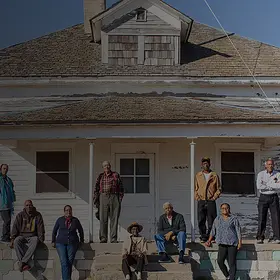
Arizona Motel at Risk
By Heather McMahon | Online Only | Nov. 18, 2010
A piece of Americana in Mesa, Ariz., is in limbo after the death of its longtime owner. The Buckhorn Baths motel has been closed since 1999 and is located on 15 acres in the middle of a commercial area, putting it at risk for development.
Ted and Alice Sliger developed the Buckhorn Baths as a cottage motel and operated the business for more than 60 years. (Alice Sliger died on Nov. 9 at the age of 103). The eclectic, Pueblo Revival-style building opened in 1939, when the Sligers discovered hot mineral springs on their land. The healing waters were instrumental in making Mesa a seasonal stop for baseball teams in the so-called Cactus League. From 1947 to 1972, the New York (later San Francisco) Giants, with such famous players as Willie Mays and Ty Cobb, made the Buckhorn their winter home. Also known as the Buckhorn Mineral Baths and Wildlife Museum, the 15-building complex features more than 400 animals stuffed by Ted Sliger, as well as a collection of mutates, or stones used as landscape features. Located on Mesa's main commercial strip, Old US Highway 60, the motel also served as a gas station, post office, and bus stop, making it central to life in Mesa.
"Everyone remembers the Buckhorn," says Ronald Peters, local architect and board member of the Mesa Preservation Foundation, a group recently formed to save the motel and preserve other examples of local heritage. "There's been such a groundswell to save it."
Earlier this year the Society for Commercial Archaeology named the National Register-listed motel one of this year's Most Endangered Roadside Places. The Arizona Preservation Foundation listed the Buckhorn as one of the state's Most Endangered Historic Places in 2005 and 2007.
Jim McPherson, a member of the board of directors of the Arizona Preservation Foundation, sees potential in the Pueblo Revival-style motel. "It's an extensive property, well-preserved, and could be utilized for a number of purposes, including mixed-use," he says.
The Mesa Preservation Foundation hopes to acquire the property and restore the baths as well as a few of the original cottages. Although still in their initial stages, plans for the remainder of the land include a sports complex for Little League teams, in keeping with the site's baseball legacy.
"The Buckhorn is such a unique part of the history of Mesa, and was so important to the development of this part of Arizona," Peters says. "To see it disappear would be a real injustice."
For more photos, stories, and tips, subscribe to the print edition of Preservation magazine.
Subscribe to the Today's News RSS feed
Comments


Submitted by MESA at: December 20, 2010
PLEASE SAVE THIS TREASURE! WE WILL NEVER SEE ANYTHING LIKE THIS AGAIN. THESE BEAUTIFUL PLACES ARE ALL BUT GONE. SAVE IT FOR GENERATIONS!! PLEASE!
Submitted by NastiJ at: November 30, 2010
Also at risk is the iconic Starlite Motel's neon sign, after it blew down in recent heavy weather: Group moves to fix Mesa diving-lady sign "The non-profit Mesa Preservation Foundation plans to file incorporation documents Monday, signaling the official start of a nationwide drive to restore Mesa's iconic diving-lady neon sign, which was blown down in a storm nearly two months ago. Mesa sign maker Larry Graham and historic preservationists are dedicated to using as many original parts as possible in restoring the 50-year-old animated sign, which crashed into the Starlite Motel's parking lot during a severe windstorm on Oct. 5, shearing it off a pole." Read more: http://www.azcentral.com/arizonarepublic/local/articles/2010/11/28/20101128mesa-diving-lady-sign-fix.html#ixzz16oUBcxoD
Submitted by Anonymous at: November 22, 2010
I'm glad to hear this slice of Arizona roadside history is being saved. However, as my baseball researcher friend (and member of SABRE) says, "the writer mentions Ty Cobb, but he was never associated with either the NY or SF Giants. He had 22 years w/ the Detroit Tigers and 2 years w/the Philadelphia A's, and was out of baseball long before the Buckhorn emerged." Perhaps Ms. McCahon should have checked her facts with the Society for American Baseball Research (SABRE).