Lost: Orson Welles' School
By Margaret Foster | Online Only | Apr. 30, 2010
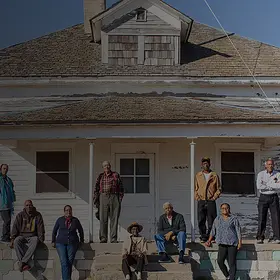
A 1915 Prairie Style building where the actor and director Orson Welles lived as a student is being demolished. The 7,300-square-foot structure was once a dormitory at the Todd School for Boys, where Welles was enrolled from 1926 until 1931. He lived in Grace Hall and studied film and radio in its basement studio.
Crews began taking down Grace Hall yesterday morning, hours after the city issued final permits. Woodstock Christian Life Services, which has owned Grace Hall for more than 53 years, plans to build four duplex houses on the site.
"For nearly two years we listened to all kinds of suggestions on how we could reuse the building," says Deborah Rabine, director of marketing and public relations for Woodstock Christian Life Services. "There was just not a fit. … That building was in the very center of the property that we are developing."
Woodstock Christian Life Services offered the building for sale for $1 to anyone who would move it, but there were no takers.
"It's a very sad sight to see something that beautiful reduced to rubble, and reduced to rubble so [eight] people can live in a duplex," says Woodstock resident Caryl Lemanski, who grew up in Grace Hall, the daughter of two teachers. "The city says that they're into [being] a historic destination, and yet they allow this to happen."
Last July the city council cleared the way for Woodstock Christian Life Services' duplex project and demolition of Grace Hall. No laws prevent an owner from demolishing a building in Woodstock. The City does impose a delay and hearing process for city landmarks—but Grace Hall wasn't a designated landmark. "We have a historic district in our downtown, but this property is not within that area, so it's not protected," says Jim Kastner, planning and zoning administrator for the city.
Working for Grace Hall
The Midwest Office of the National Trust joined forced with Landmarks Illinois, the Illinois Historic Preservation Agency, and the Woodstock Historic Preservation Commission to propose a meeting with the property owners and discuss their long-range plans, their needs for the new senior housing duplex, and possible options for rehabilitating Grace Hall to serve that purpose. In subsequent meetings the Midwest Office provided the owners and their consultants with information on various tax incentives and loan programs that could help finance the rehabilitation of Grace Hall as senior housing, allowing it to stay in place and still meet the needs of WCLS. It also offered grant funding to offset the cost of a feasibility study or other planning documents that would define the scope of the rehabilitation.
Grace Hall could have been landmarked last year. Lemanski submitted a local landmark nomination for the building in 2008. The City's Historic Preservation Commission in December 2008 voted unanimously to designate Grace Hall as a landmark, passing the final vote to the city council. But a motion to protect the structure was never placed on the council's agenda.
"They tabled the landmark recommendation and never took it up again," says Allen Stebbins, chair of the Woodstock Historic Preservation Commission.
Although two nonprofits—the National Trust for Historic Preservation and Landmarks Illinois—tried to obtain grants and funding for Woodstock Christian Life Services to restore Grace Hall and transform the building into senior housing, the owner maintained that restoration was not economically feasible.
Lemanski watched the demolition begin yesterday. Grace Hall was also home to hundreds of foster children. "We've heard from a number of those people who said that living there was the only stable thing in our lives. It's sad that those kids have lost so much of their heritage."
The loss of Grace Hall may spur a comprehensive survey of Woodstock's historic assets. "As a result of this issue, our city council has asked our commission to look outside the [historic] district and try to identify [buildings] as historic," Stebbins says. But, he adds, "the survey is dependent on funding."
For more photos, stories, and tips, subscribe to the print edition of Preservation magazine.
Subscribe to the Today's News RSS feed
Comments


Submitted by Pat at: May 7, 2010
This is a great tragedy for your city. It is such a shame that people only look at the financials and not the beauty and historic details. Companies have gotten to big to have a heart. Everything is computerized so that nobody cares anymore. I still think that it is cheaper to repair buildings than to tear it down which is bad for th economy and for the environment. I hope that Woodstock Life Services goes broke and will always regret their decision to demolish such a beautiful piece of history.
Submitted by Heartbroken at: May 6, 2010
How sad that they cannot see the true value in such a building, a landmark, that they would destroy this piece of history so they can build duplex houses that could have been built anywhere. Such a shame for their ignorance and stupidity.
Submitted by Disgusted at: May 6, 2010
We are facing the same situation here in Maryland with a "faith based" owner who wants to destroy its mid-century sanctuary designed by a prominent local architect (for a mixed-use project) and an ineffectual county government that does nothing to help preserve our heritage.
Submitted by e.m. at: May 6, 2010
Although I appreciate the mission of WCLS, I do not understand how an organization that values its own history and works to support community members in need would senselessly demolish a building that is important to the history of the community it claims to support. As an employee of a nonprofit, I understand that finances often make the decisions for charities, but it seems to me that resources and some funding was being made availably to support a win-win for the historic preservation community and the WCLS. Such a shame.
Submitted by Jac at: May 6, 2010
Shame on WCLS and the City Council for 'tabling' the recommendation!! Apparently the "fit" was to replace a beautiful old building with more cheap junk!
Submitted by chrissygnj at: May 6, 2010
Could the bricks be salvaged and be sold to collectors or reused in the new houses? What a shame..Woodstock Christian Life Services doesn't seem to have a feel for history only the Almighty DOLLAR! Hmmm; WWJD?
Submitted by TaxiManSteve at: May 1, 2010
Culture wars...? Just what the world needs more of... duplex houses... (sigh)
Submitted by Gus Philpott at: April 30, 2010
Demolition began minutes, not hours, after the Permit was issued. The City called me at 8:55AM Thursday; a neighbor heard glass breaking at 9:00AM. Woodstock Christian Life Services' offer to sell for $1 was a joke. The HPC's recommendation for Landmark designation did make it to the 4/21/09 City Council Agenda. The Mayor tabled it, and neither he nor any of the six councilpersons ever brought it back to the Agenda; thus, acting in a shameful, and most likely, improper manner by not following Robert's Rules of Order. Even at the first Public Hearing of the HPC, the HPC got poor legal advice from the City Attorney's office and allowed a ploy by the building owner's attorney to succeed.
Submitted by Robert at: April 30, 2010
You can't build an old building. Such a shame this treasure is gone