Looking Back—and Ahead—at Drayton Hall
How a House Museum Was Born
By Arnold Berke | Online Only | Jan. 4, 2010
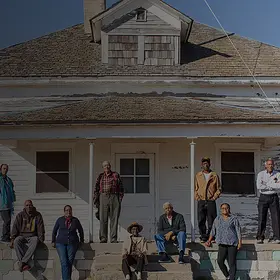
Charles Drayton and his great-grandchildren on the steps of Drayton Hall in Charleston, S.C.
Credit: Drayton Hall
Thirty-five years ago, the National Trust for Historic Preservation acquired Drayton Hall, one of America's most celebrated colonial houses, from brothers Charles and Francis Drayton. In early December 2009, Preservation Executive Editor Arnold Berke spoke with Charles—born in 1918 and a seventh-generation descendant of builder John Drayton—as he recalled a lifetime of association with the 1742 house, the land, and the lives linked closely to both.
You were born in Charleston and grew up there?
CD: Yes, and I lived downtown on Tradd Street. After I got out of college, five days later I was an ensign in the Navy. It just followed suit. I resigned from the Navy afterwards and went to work in insurance.
One of the primary players in the long story of the house was your Aunt Charlotta Drayton, the last of the family to live there. What do you remember of visiting her during your childhood?
CD: She would go out to the house every spring, and I'd often go, too, and spend a weekend or maybe as much as two weeks. I usually had a friend of mine go out with me. And of course, with no electricity, it was early to bed and early to rise. We'd climb trees, do some fishing and hunting. And often I'd have a bunch of us out and we'd play ball. Right in front of the house.
She loved tea, and she served it every afternoon. She always had a friend staying with her, and a lot of people would come out just for the afternoon to see her. She stayed from six weeks to two months, but would be out of there by early May, because of the heat and the bugs. She'd either go back to Charleston or overseas.
Did Charlotta specify in her will that the house be preserved?
CD: Yes. She always told us that. She didn't want it changed. I think she'd really be pleased with the way it looks now. There's no question about that.
What happened after her death in 1969?
CD: The caretaker still lived there, but after a few years, he left. That's when we started having break-ins. Some furniture was stolen, a mantelpiece, various things. It turned out to be high-school students, who learned the place was unguarded. I did insure the property, but taxes and maintenance were more than my brother and I could handle. We never put it up for sale. I got a call from somebody who I didn't know, wanting to buy it. I said, "What are you planning on doing to the house?" He said, "I'd like to make it a clubhouse and have a golf course built there." I didn't think much of that idea.
So I approached a friend of mine, Peter Manigault, head of the News and Courier paper in Charleston and a vice chairman of the National Trust, wondering whether the Trust would be interested. In 1971, the Trust had its annual convention in Charleston, and Peter suggested I open Drayton up for that. There were so many of them here; I held it for two days. They were very impressed, and made me an offer. I accepted, because I thought, in the interests of the family, and the house—the house particularly—it was a good idea. I've made two or three smart moves in my life, the first being my wife, and selling Drayton was certainly the second.
It's amazing that both your family and that of the late Richmond Bowens [who worked at the property for years] go all the way back to Barbados [where John Drayton's father had emigrated].
CD: That's correct, and that's incredible. Richmond Bowens was what I call a real gentleman. A wonderful guy. He worked for my father prior to World War II, then went to Chicago until after the war, when he came back. He told me how pleased he was with what we had done with Drayton Hall. He said, "I have a serious request. I was born there, grew up there, it's my home, and I'd like to be buried there." So I made arrangements for him to be buried. His was the first burial [in 1998] after acquisition by the National Trust. I got him a job [in his later years] as the gatekeeper, which he had for a long time. People loved to chat with him.
During your life, looking back on your visits, how has the landscape changed at Drayton Hall?
CD: Two big changes: When I was growing up, there were probably 12 to 15 houses where the people lived. They didn't work for Drayton Hall, but they lived there and worked elsewhere. But they kept their places cultivated. All those are gone now. Originally, they were servants at the house and field hands, but before my time, though. I remember the houses well.
Also, two hurricanes did a considerable amount of damage to the property between the house and the river. Those were drastic changes.
In terms of controlling development in the Ashley River corridor, what does the future look like?
CD: Well, it looked very dim up until recently because one family sold their property to North Charleston, and created a corridor across the Ashley River. And they were going go buy a very sizable piece of property and put thousands of homes there, and a golf course. It was further up the river, but nevertheless the traffic would have been fantastic. ... They're going to develop it, but on a much smaller scale. Read more
What is your vision of the future of Drayton Hall?
CD: I hope they can get an interpretive center built and display the furnishings, the record-keeping, and everything about the family. Right now, everything is under lock and key. I know some people who visit there are very disappointed that there's no furniture in the house.
I know there are plans now to bring in money now to build the interpretive center, which will be out of sight of the house. It's still my hope that it's finished in my lifetime, but I'm not sure it's going to happen. Right now, there are three phases to the story, and only two phases are available—the house itself and the grounds. But the family is really not visible, and I would love to see it visible.
Your family gathers outside Drayton Hall every Thanksgiving?
CD: It's closed Thanksgiving, Christmas, and New Year's, so we have sort of the run of the old place. We go down by the oak tree. Had a perfectly beautiful Thanksgiving this time, and just to meet each other again, and have fun. … It's become a family tradition. We've been doing it for a number of years now. And Drayton Hall has always been great to the family.
Read more about National Trust Historic Sites
Arnold Berke is executive editor of Preservation magazine.
For more photos, stories, and tips, subscribe to the print edition of Preservation magazine.
Subscribe to the Today's News RSS feed
Comments


Submitted by Jeri at: January 21, 2010
Many years ago, before the Trust acquired Drayton Hall, my husband and I were privileged to visit the mansion. We had permission to enter and were accompanied by Peter Manigault and Sam Stoney - another special treat. I still have the photographs my husband took of the amazing woodwork. I remember being told that whenever the family held parties at the house, they had people stationed in a corner of each room with equipment to put out any fire that might start.
Submitted by Chris at: January 18, 2010
My wife and I visited the house and grounds last July. This was our first time in South Carolina. We did not hesitate to join the National Trust as we were very impressed with the tour and the friendly people working on site. The showed a genuine interst and concern for the house and grounds. We highly recommend to all visitors of the Charleston area to stop and see Drayton Hall. You will not be disappointed and will remember your time spent there long after you have gone.
Submitted by Anonymous at: January 18, 2010
my name is drayton and so was my mothers I to am interested in the family name.
Submitted by Madalyn at: January 17, 2010
If it weren't for Drayton Hall, I wouldn't be a member of the National Trust. The first time I saw Drayton, it wasn't open to the public, but work had commenced on restoration. We were allowed to look around through accessible areas, and in gratitude for what the National Trust was doing, I became a member and a firm believer in the cause. I now live in Summerville, and it is in part due to the beauty of Drayton, Middleton, and Magnolia. Three of the most beautiful places on earth.
Submitted by Donna at: January 14, 2010
My husband and I visited Drayton Hall many years ago, and I can still see every detail when I close my eyes. I have visited many historic homes from coast to coast, and this one left a lifetime impression. You feel as if you have walked back in time. I love the fact that it has not been "dressed up". You can almost feel the generations who lived there.
Submitted by steve at: January 13, 2010
Captivating place. It stays in your mind well after your visit. One of America's most valuable landmarks. After viewing the house I understand why it is not furnished. The architecture is simply amazing and totally original. It is unbelieveable that this home was never modernized with gas, water, or electricity. You get to see it as it was. Now that I have made alll thesenice comments I must also tell you it is haunted. My haunting began as dreams. Dreams of amazing weddings held in the 17 and 18 hundreds. The dreams are always of parties and get togethers. The boats pusll up in the rear of the house (Ashley river) and fols are then transported via sedan chairs to the "big house". Hey I'm just telling you what I dreamed you take it from there. Suggestion: While there is no furniture How about some nice period chandeliers....If anybody else has had a dream abouit this place I would be interedted in hearing from you....Steve at 1-616-361- 8246
Submitted by Karen at: January 13, 2010
Having visited Drayton Hall several times since the early 80's I find it always willing to tell one more story. The decorative plasters and carvings,inside stairways from the basement kitchen, the stories of Mrs Drayton's multiple attempts to have children and the subsequent recordings of those heights on the doorframe, the stories of protecting the property from the roving, destructive Union soldiers are all the more poignant without the furnishings. The incredible home stands on its own to tell the Drayton story. I would love to see the interpretive center, either in an accurately placed recreation of an actual outbuilding or situated so as not to detract from the home's setting. I remember my first visit, walking from the river toward the river-front of the house amid flowering azaleas and imagining I had just arrived by boat from Charleston - to have this home intact for us is truly a gift from the Drayton family and the National Trust!
Submitted by Tina at: January 12, 2010
I'm in California and wish that tourists here would consider visiting the US before foreign destinations. I visited Drayton Hall in 2003, as well as the neighboring Magnolia Plantation & Middleton Place. Drayton Hall was the most poignant reminder of how much has been lost, whether to the Union army or to lapse of time, lack of interest, money, and the like. Thank you for preserving Drayton Hall. I didn't mind that it didn't have furniture. The only other place I visited that evokes the same type of atmosphere as Drayton Hall is the Aiken Rhett House in Charleston. It is a different type of setting but they both take the visitor back in time. Thank you for preserving it for us and I wish you much success in the future.
Submitted by BonnieB at: January 12, 2010
It is a dream of mine to one day visit Drayton Hall. I admire so much the handling of the property "as is" with the barest of maintenance and highest of preservation. Thank you for this article. Any publicity Drayton Hall can receive to help it remain part of our living history is wonderful.
Submitted by Bruce at: January 12, 2010
Great article...thanks! One comment...I was very impressed that the house didn't have any furniture, and it offered me a very unique perspective which I've never forgoten. Another thing I particularly remember was the kids heights which were marked on the wall.
Submitted by Ellie at: January 12, 2010
I found this interview very interesting, thank you. About 25 yrs. ago,my husband, young daughter, and I traveled to Charleston after visiting an uncle in Fort Sumter. I remember traveling down lovely Ashley River Rd.(?name?) with the trees and moss hanging over to shade the road. We were going to see another plantation and passed by the majestic Drayton Hall. It was such a pretty area. It would be ashame to lose that with overdevelopment.
Submitted by Bill at: January 5, 2010
Being one of Charles' English cousins, and also having visited Charleston and Drayton Hall on 4 occasions over the 4 years, I am grateful for the National Trust to have interviewed Charles. I feel very much connected to Charleston and to my family roots there. If you are interested, I have my own website - www.grimke.co.uk. I shall be printing this out for my father, who will be very interested to read it, I know!!