Mapping African American Historic Places in the Northeast Region

ME, VT, NH, MA, RI, CT, NY, NJ, PA, DE Connecticut, Maine, Massachusetts, New Hampshire, New Jersey, New York, Pennsylvania, Rhode Island, Vermont

Introduction

Mapping has numerous applications within the field of historic preservation. Commonly employed in architectural and cultural resource surveys, it is used to understand how individual sites fit into their larger geographic context. Locational data helps expose meaningful relationships between structures, landscapes, and other resources in a way that contributes to a more holistic appreciation of the significance of these places and their settings. Until fairly recently, however, mapping was a task largely reserved for specialists, utilizing sophisticated, and often expensive, cartographic software to carry out complex spatial analyses. This state of affairs has changed with the emergence of web based mapping platforms, such as Google Earth and Google Maps.  These user-friendly programs can be employed to create engaging maps for educational, research, and promotional purposes, even by people with little-to-no training in computer science or geography.  Capitalizing on these advances, the National Trust for Historic Preservation's Northeast Regional Office used Google Earth to construct a web map of the Northeast's most significant African American historic sites. The process of developing this map serves as a model which may be of interest to preservation organizations and historic sites hoping to utilize this technology for their own cartographic endeavors.

Conceptualizing the Map: Project Background, Planning, and Scope

The success of any mapping project hinges on proper planning.  It is crucial that the questions of who, what, where, when, and why be addressed before the work of constructing the map begins. Who will use the map? What information will it convey? Where is the map's focus? When will the map need to be completed? Why is mapping useful in this context? Answering these questions at the outset serves to clearly define the map's audience, content, and goals and helps to avoid complications that could be time consuming to correct during later phases of the project.

The Northeast African American Historic Places Map (NAAHPM) is one aspect of a broader regional program aimed at extending support to individuals and groups working to preserve African American history in the region. The mapping component is designed as a resource for preservationists, planners, historians, and students interested in researching regional efforts to preserve African American historic places. In addition, the map serves as an educational tool for the general public, a means of raising awareness of African American history in the Northeast. Finally, it is hoped the map serves to help promote African American historic sites as heritage tourism destinations.

Initially, the map's primary dataset, gathered through a systematic survey of the region, was to consist exclusively of public African American historic sites. What constitutes an "African American historic site" was defined from the outset as any organization using a historic structure or landscape to interpret some aspect of the Northeast's African American past for a public audience. This relatively broad definition enabled us to include sites that focus solely on the black experience in a particular location, such as the Museum of African American History in Boston and Nantucket, MA, as well as sites that incorporate African American history into a broader interpretative and educational program, such as Joseph Lloyd Manor on Long Island, NY. As the survey went on, we extended our definition to include what we termed "active preservation projects," a category including significant African American historic structures that are either threatened or in the process of being preserved, rehabilitated, or restored.  Although these places are not yet open to the public, we felt their inclusion was relevant given the map's goal of promoting and supporting these types of efforts.  

We were also forced to expand our view of what would be included in the map when confronted with the region's numerous self-guided black heritage and freedom trails. These trails range in size and geographic scope, from only a few sites located in a single municipality, to several dozen sites spread throughout an entire state. They are distinctive for their use of a multi-sited approach to describing and contextualizing historical events, people, and communities. While heritage trails usually are organized and marketed for a public audience, many of their constituent parts are private residences or businesses, what might be called "drive by" sites. To balance the desire to include these privately-owned structures with our overarching mission focused on public venues, we created a two-tiered system in which public sites and active preservation projects would be termed "Featured Sites" and trail sites would be considered "Secondary Sites." The difference in classification is manifest in the level of descriptive detail accompanying each site type, which will be discussed in greater detail below.

As a final planning consideration, we also found it useful to define the types of historic topics and themes that might be included under the heading "African American history." For example, can a historic house museum reputed to have been a stop on the Underground Railroad be considered an African American historic site? What about the house of a prominent abolitionist? In the end, both were included for their obvious connections to important aspects of African American history in the Northeast. Nevertheless, working through these kinds of questions early in the project's planning stage helped us to clearly delineate the scope of the map and focused our efforts on a well-defined content group. 

Developing the Map: Methods, Timeframe, and Results

To develop the map, we used Google Earth, a downloadable mapping application consisting of a virtual globe and various preloaded base data layers, including satellite imagery, roadways, and geo-political boundaries. Other interesting layers are also included with the software, such as "street view" and 3D building models, though the coverage of these layers is not universal. Google Maps is a related web-based mapping tool, but lacks some of the functionality and creative control available with Google Earth.  Most content generated in Google Earth can be uploaded and viewed in Google Maps if needed.

Collecting the information to display in the map was the project's most time consuming task. In our case, we sought to include a historic or contemporary photograph of the site and a text describing the historical significance of the place as well as its present day use or condition. Some of this content was obtained with the help of representatives from potential project participants, who usually provided their own images and text. This saved our office valuable time and effort, while also giving the sites the chance to convey their own message through the map. For sites that could not be reached, we deferred to the organization's website for the necessary information.

The map took approximately three months for one full-time intern to build and required only minimal knowledge of HTML. The flexibility of Google Earth allows developers to make their maps as basic or sophisticated as their level of technological expertise allows. Numerous websites provide detailed overviews of the product, as well as tutorials and how-to demonstrations that take one through the process of making a map. These resources, some of which are provided below, should be utilized readily by anyone hoping to implement mapping in their own preservation efforts.

At present, the NAAHPM features 109 public historic sites and active preservation projects, and includes the location of over 300 individual sites in total, located in all ten of the region's states, from Maine to Delaware.  Featured sites are accompanied by a brief statement about their significance and history, a link to the organization or steward's website, and, in most instances, an image of the resource (see image 2). Secondary sites are accompanied only by a description and website link. In many areas, users may enable the "street view" layer to see a 360 degree panoramic picture of the historic structure and its surroundings. This dynamic virtual experience is akin to actually visiting the site in person. For users seeking to compliment their virtual tour by traveling to the site (which we hope will be all users), driving directions are easily accessible through Google Earth.

A diverse set of historical topics and themes are represented on the map, ranging from the role of slavery in the north to the origins of jazz music. The map  will lead users to houses that once served as stops on the Underground Railroad, to one of the oldest African American cemeteries in the United States, and to the center of Portland Maine's nineteenth century black community, in addition to many others. Taken as a whole, the map paints a compelling and conveniently accessible portrait of the Northeast's African American history as revealed through its many landmarks, structural and otherwise. 

Building Community through Mapping

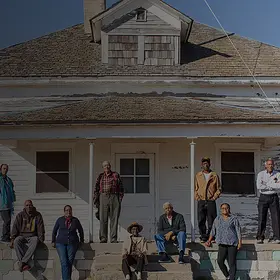
A draft version of the map was unveiled in late January 2010 during a presentation at the Northeast African American Historic Sites Sustainability Workshop in Providence, RI (see image 3). The workshop was attended by leaders from 24 historic sites in the region, all of which are represented in the map. Although the goal was to provide training in the areas of fundraising, planning, and responsible site stewardship, an encouraging by-product of the convening was that it provided an opportunity for attendees to meet and exchange ideas with other similarly-focused preservationists. Within this context, the map acted as a concrete expression of an emerging community formed around a regional network of historic sites and the people working to preserve them. In a sense, being a part of the map can be viewed as a form of honorific designation for the community's constituents. Several attendees, since learning of their inclusion in the map, have cited it in grant applications and media outreach.

A Useful Tool for Preservationists Everywhere

While the form and content of the NAAHPM is determined primarily by the particular interests and goals of the Northeast Office's African American Historic Places Program, the project's overall process and results might serve as a model for similar efforts nationwide.  For our office, the map offers a way of instilling a regionally-based perspective on preservation efforts while at the same time recognizing individual projects. It is often said that all preservation is local. The idea behind this simple phrase is that, from a preservation standpoint, historic structures and landscapes tend to be most meaningful to those living in their immediate vicinity. What web-based mapping applications provide is a venue for people to develop this type of relationship with historic places far removed from their own communities, to feel connected to a geographically, culturally, and historically diverse group of places. Ultimately, this is what makes NAAHPM, and projects like it, a valuable contribution to the preservation movement more broadly.

Instructions for Exploring African American Historic Places in Google Earth

Using the map is simple and fun!  Just follow the steps below:

  1. Download and install the free Google Earth software
  2. Download the Northeast African American Historic Places Map.
  3. When the download is complete, simply double-click on the file to open it. Google Earth will automatically launch and zoom to the ten  states of the Northeast. By clicking on the lower case "i" at the center of screen you will open an introductory balloon with directions on how to navigate through the map. Also visible are a number of red and blue markers. Blue markers indicate the location of "featured sites" while red markers indicate the location of individual sites included on black heritage or freedom trails.
  4. To zoom to a historic site and view its descriptive balloon and image, either double-click the marker on the map or expand the state folders in the "Places" panel on the left side of the screen and double-click on the site name there.  After clicking on the site marker, you will "fly to" or descend to the site's immediate location. At this point, you may want to turn on other layers, such as "Street View" or "3D Buildings" (if available), by clicking them in the "layers" panel to the bottom left.
  5. Once you are finished visiting your first site, you may either use your mouse to navigate to other sites in the vicinity, if there are any, or return to a wider view. To zoom out, double-click the "introduction" icon in the "places" panel or use the navigation toggles in the upper right hand corner of the screen.
  6. To save the map, right-click on the file name in the "places" panel (African American Historic Places Map) and click on "save to my places." If you close Google Earth without saving the map, a prompt will open asking whether or not you want to save the map to your "My Places" folder. Click yes. Now the map will be available anytime Google Earth is opened.

Did you not find your favorite African American historic site on the map? Tell us! We are eager to add new content.

Trevor Johnson is a 1772 Foundation Fellow placed in the National Trust’s Northeast Office in Boston, MA.  

Powered by Convio
nonprofit software