Edward Lee McClain High School

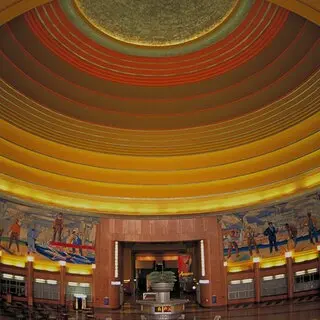
With approximately 200 paintings, murals, statues, and other artwork adorning its hallways and classrooms, the Edward Lee McClain High School stands tall and proud in the small community of Greenfield, Ohio. The school, built in 1915, had been a leader in education and the pride of town. Edward McClain, the school`s beneficiary, included luxuries that far surpass most of today`s schools, with such amenities as an auditorium lit by amber Tiffany lamps, monogrammed china and silver, and rooftop gardens. In a time of one-room schoolhouses, McClain was soon joined by an elementary school and a vocational school, creating a single campus of buildings - almost unheard of in the early 1900s and further establishing its unique educational opportunities.

But after almost 85 years of wear and poor remodeling, Greenfield`s once revolutionary school had become outdated and was in desperate need of restoration. TRIAD Architects worked closely with the community, school board, and the Ohio School Facilities Commission (OSFC) to renovate the treasured buildings. Because the cost to renovate was more than 2/3 of the cost of replacement, the community feared that they would have to forfeit their state funding to keep their building. TRIAD worked closely with the School Board and prepared a compelling case for the historical significance of the campus. The OSFC agreed to change its regulation to allow for exceptions to the 2/3 rule, making the Greenfield the first to qualify. TRIAD also reviewed the Master Plan and found that the funding was less than adequate. The OSFC reviewed their evaluation and added $4 million to the plan.

Although TRIAD uses a community-based planning and design process, many community members were still suspicious of plans to - once again - renovate and restore their treasured buildings. Previous renovations that did not involve the community had led to shock and disappointment. When the original elementary school became the middle school and a one-story elementary school was added in 1957, its small, plain frame detracted from the grand campus and was an unwelcome addition. Throughout the years, new walls have covered marble tiles, air conditioning ductwork has been exposed on the exterior of each building, and ventilation units have punched holes through the high school`s front facade. Prior to the renovation, holes scattered across the floors, battered lockers intruded on the art-filled hallways, and windows were deteriorating.

When TRIAD began the project, they approached the community with the situation. Finally able to express their concerns, the community swiftly responded to the meetings. Because the community actively participated in the community meetings, their concerns led the design direction.

Preserving McClain`s original style was a clear concern voiced by the community. TRIAD responded by adding a second story to the elementary, maintaining consistency with the large high school and middle school. They also relocated the unsightly lockers from the hallways and restored the arcade that unites the campus.

Restoring the school as a community center was also a priority for Greenfield citizens. Historically, the schools had been used for many more events and formal affairs. Although the campus is still buzzing with community activities, the lack of a large, elegant space for community and school events was a concern. Expanding the current dining area would have been impossible because it surrounds a two-story boiler room. To fix the problem, TRIAD changed the mechanical system to a smaller, more efficient system and relocated it. They also restored the five sets of French doors that open to the garden, added Tuscan columns, replaced the acoustic ceiling, and replaced florescent light fixtures with crystal pendant fixtures.

While restoring the school`s history was important to the Greenfield community, equipping students with 21st century technology was also a priority. Because each room only had one plug, TRIAD relocated wires and pipes into the thick walls, existing chase way systems, and the old central vacuum cleaning system. Much of the technical wiring was placed in current or created soffits. These soffits create an added bonus of direct light fixtures for the chalkboards and walls. The renovations are non-intrusive and preserve the original hard plaster ceilings, as well as the original wood floor and cabinets.

Despite initial skepticism, the community`s positive and fundamental role in the process has led to renewed pride in their school. Now that renovations are complete, Greenfield community can again enjoy the tradition and elegance that they knew almost 85 years ago. As Greenfield Superintendent Phillip Cornett said it best: "It`s an excellent compromise of what it was and what it will be in the future."

Powered by Convio