Restoration of Radio City Music Hall
New York| Posted: 10/06/2000
At the time of its opening in 1932, Radio City Music Hall was widely considered to be among the most modern and beautiful theaters in the world. The New York Herald Tribune called it "the most remarkable auditorium ever built." No one had ever seen anything like it, an astonishing design of luxury and sophistication all for the enjoyment of the general public.
Like Rockefeller Center itself, Radio City`s design was the product of collaboration. Three architectural firms collectively called the Associated Architects, together with many artists and designers, contributed to the dramatic design, but it was acclaimed designer Donald Deskey who brought everything together in a celebration of American Modernism. The Hall was planned to be the ultimate in theater experience, offering the biggest and the best of everything. Architects and builders anticipated it would represent a new era in theatrical design. "[There] is not to be found a single chubby wooden cherub, not one bursting cornucopia of gilded plenty," wrote the Herald Tribune. The Hall was equally modern in its furnishings, interior finishes and art collection.
By the 1940s, Radio City had become the biggest single attraction in New York. Its magic captured the attention of Hollywood during this era, and became the city`s most prestigious location for film premieres. However, in 1978 dwindling attendance and enormous weekly operating costs forced the Hall to close. With demolition imminent, the Hall received a last- minute reprieve in the form of the city`s first interior landmark designation, which resulted in a $5 million renovation.
Major and minor renovations throughout the Hall`s history, while well intentioned, strayed from the original patterns, colors and materials. Built to celebrate what is new, Radio City became a pale copy of its 1930s splendor. A $70 million restoration now has brought the 500,000-square-foot Hall back to life in keeping with the expectations of contemporary patrons. More than 30 spaces are restored, including the Auditorium, Grand Foyer, Grand Lounge, mezzanines, lobbies, smoking rooms, powder rooms and lounges. After painstaking research of various archives-- including those of Radio City Music Hall, the Museum of the City of New York, and the Deskey archives at the Cooper-Hewitt National Design Museum--photographs and newspaper clippings were used to recreate custom fabrics and furnishings that were missing for decades. To heighten its nighttime drama, new marquees feature red-and-blue neon piping and gold lettering not seen since the 1930s.
The Hall`s art collection, one of the highlights of the design, has been cleaned and restored as part of the project. The most significant work, a Stuart Davis mural, was returned to a restored Grand Lounge men`s smoking room after being donated to the Museum of Modem Art in 1974, when the room was converted into a storage area. In the second mezzanine women`s powder room, a Yasuo Kuniyoshi mural that was over-painted in 1963 was recreated based on the artist`s sketches. In the Grand Foyer, conservationists removed layers of varnish that darkened Ezra Winter`s immense Fountain of Youth mural, one of the most visible symbols of the Hall`s renewal.
The 5,901-seat Auditorium has new seating replicating the original, as well as a rewoven Deskey-designed carpet, Singing Woman, in its original color scheme. The 60-foot-high proscenium features a new, gold-silk house curtain, and the wall fabric designed by artist Ruth Reeves has been recreated so that its full pattern is again visible. This design of singers, musical instruments and other theater images had been reduced during a previous restoration-a detail uncovered through research.
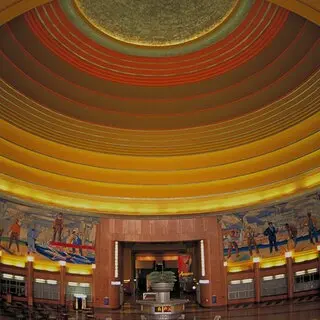
In the 65-foot-high Grand Foyer, one of the Hall`s most awe-inspiring spaces, over the years had turned varied shades of brown. Restoration brought back Ruth Reeves` abstract carpet design of musical instruments, the red brocatelle wall covering, four-story-high gold drapes, and the gold-tinted, metal-leaf stair fascias and ceiling. Additional lighting and computerized spotlights subtly enhance illumination of the space.
Restoration also improved back-of-house areas and theater technologies, with new production lighting, sound systems, stage rigging, and upgraded mechanical and structural infrastructures. A new power room enables cable wiring and sound-control equipment for television broadcast, while 35 camera positions accommodate high-definition television.
Built to define "what`s new," Radio City is again a contemporary wonder, a home for popular entertainment of unmatched distinction and sophistication. Imbued with the original`s progressive spirit, this technologically advanced, elegant public hall welcomes a new generation of entertainment in high style.
For more information contact:
Radio City Music Hall
Two Pennsylvania Plaza, 16th Floor
New York, NY 10121
212-6331-4345
Hardy Holzman Pfeiffer Assoc.
902 Broadway, 19th Floor
New York, NY 10010
212-677-6030