The Perfect Storm
Issue: Windows & Weatherization
Despite what you might hear, retaining and repairing existing windows is a cost-effective, energy-efficient approach to weatherization.
Issue: School Rehabilitation
Funding for school rehabilitation is eligible under stimulus spending if advocates participate in the decision-making process and make a compelling case.
Issue: Transit Upgrades & Repair
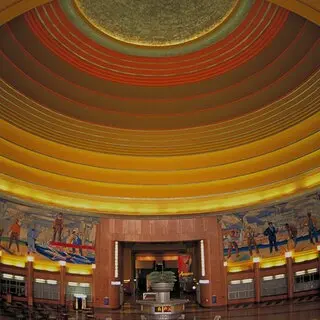
Historic train stations can benefit from new stimulus funding for long-needed rehabilitations and upgrades.
Issue: State Funding Cuts
Funding cuts for state historic preservation offices, Main Street programs and heritage areas threaten the future of thousands of historic places.
Issue: Neighborhood Stabilization
Funding set aside for neighborhood stabilization can be used to rehabilitate rather than demolish vacant and abandoned housing.
Issue: Roadway Improvements
Shovel-ready roadway construction projects may impact historic features, prompting the need for thorough review procedures to ensure that alternatives are considered.
Issue: Energy Efficiency Housing Retrofits
Funding for energy efficiency and weatherization doesn't need to come at the expense of historic buildings and their original windows and openings.
Update
More than 200 participants from 46 states representing preservation groups at the local, state and national levels came together in March for a series of Perfect Storm conference calls, during which stories were shared about the likely impacts of state budget cuts and the need for staffing to address the influx of stimulus funding.
The stimulus presents an unprecedented opportunity for funding "preservation-ready" projects that will generate jobs and build the economy. Preservationists need to be proactive in pitching projects and gaining support for funding if we are going to be successful. We also need to be ready for potential conflicts, such as developing creative approaches for staffing to avoid unnecessary delays in reviewing projects. The National Trust is helping by providing tools and a roadmap. Soon, an online Weatherization Guide for Older Buildings will be available to help address concerns regarding stimulus funds for energy retrofits and weatherization and their impact on historic places.
What is the Perfect Storm?
The perfect storm is created when a flood of new stimulus dollars intended for "shovel-ready" projects hits the ground at the exact same moment when state governments are responding to widespread budget deficits and dreary bottom lines by slashing (or completely turning off) funding for historic preservation programs.

With the recent enactment of the American Recovery and Reinvestment Act, $787 billion in economic stimulus funding has started trickling down to each state. While we’ve heard a great deal over the past few months about job creation and "shovel-ready" projects, what is not being discussed is the role preservation advocates have in ensuring that each state’s share of this funding supports our cause. On one hand we have an unprecedented level of funding generated by a history-making stimulus bill that is already being disbursed. On the other, we have state historic preservation offices, Main Street programs and cultural initiatives that are experiencing deep funding cuts and very uncertain futures. This is creating an unusual situation that both threatens historic resources and offers unprecedented opportunities for their revitalization.
This is the perfect storm.
Two Things Are Happening At Once
Number One: The federal stimulus package is essentially a massive investment in our states and local communities. While focused on repairing our aging infrastructure (roads, bridges, transit, etc.), funding is also designated for neighborhood stabilization, energy upgrades and weatherization, and school modernization projects. However, the stimulus dollars are having an unanticipated side effect as state and localities are pressured to “fast-track” projects in the name of creating jobs and getting dollars out the door. This means that compliance at the state and local level with required environmental and preservation reviews may be repealed or weakened. And though federal-level reviews are required, they may be severely hindered with limited and/or strained staffing.
Number Two: Battles about funding for historic preservation are being waged across the country. In response to budget shortfalls, state governments are eliminating preservation programs, cutting funding, freezing positions, and, in some instances, completely restructuring state historic preservation offices. Additionally, while more community leaders tout Main Streets as engines for economic renewal, many states are cutting budgets that support their revitalization. Effective and successful state Main Street programs – already established within many state governments – are also threatened with severe cuts in services to their communities.
A Quick Snapshot of Some Developing Challenges
- More than 70 recreational and historic sites around the country are currently threatened with closure because of state budget shortfalls. The sites at risk include the oldest building in Idaho and a sacred Native American ancestral village in Arizona.
- In Nevada, funding for the state historic preservation office could be cut in half, and the Nevada Historical Society’s ten-person staff could be reduced to five.
- In Connecticut, a proposal is pending that would eliminate the popular Community Investment Act and suspend the state historic tax credit for two years.
- In Pennsylvania, a successful national model for heritage tourism is at risk as budget cuts threaten to eliminate funding for twelve state heritage areas.
- In Washington, the governor's proposed budget would cut the Main Street program there by 60%, leaving 85 communities without services at a critical time in their economic revitalization programs.
What Does This Mean For Preservation?
At this critical time, it is important that the effectiveness of the state historic preservation offices, Main Street programs, certified local governments and others are not curtailed. As federal stimulus dollars continue to arrive in states and local communities, preservation programs will be invaluable in helping to review projects and in getting funding out the door. However, this cannot occur if there’s no staff.
Today, several state environmental and preservation review processes are threatened with repeal as an unintended consequence of stimulus funding. Legislation in some states – including a proposal in Montana and a recently-approved provision in California – will relax or exempt stimulus-funded projects from review policies. Proponents say they simply want to ensure that environmental and preservation safe guards do not get in the way of creating much-needed jobs. However, pitting jobs over proven environmental and preservation protections is not the way to go, and exploiting the stimulus spending in the name of creating jobs by fast-tracking projects is not a justifiable excuse for putting our resources at risk.
Of course, handling the sheer volume of projects for review will be a challenge. For projects that are controversial or fall short of "shovel-ready" status, state historic preservation offices will need to be ready to resolve issues, where possible, in a timely manner. Developing a system for reviewing routine projects quickly with responses will be essential.
Making Our Case (There's Still Time)
The stimulus presents an unprecedented opportunity to direct funding towards preservation and revitalization efforts. As you know, historic preservation is a proven tool for economic development and job creation. It is 20 to 40 percent more labor intensive than new construction, and it continually generates more than a dollar return on each dollar invested. As a powerful engine that drives real, sustainable economic growth, preservation can (and should) be a key strategy for our economic recovery.
Even though states have already submitted project lists for stimulus funding and some decisions have already been made about where the money will go, it’s not too late to get a piece of the pie. Decisions about how to spend the stimulus funds are still being made, and preservation advocates need to work quickly to ensure that these funds support preservation projects.
Additionally, preservation advocates in each state and locality need to identify projects that are ready to go and can be supported by a variety of funding categories within the stimulus bill. Use our stimulus 101 to identify opportunities for securing dollars. Also, use our state-by-state storm tracker to identify the stimulus spending process within your state.
Sound Off
Tell us how the perfect storm is shaping up in your state by leaving a comment below.
Comments
This story is closed to new comments.


Submitted by Anonymous at: May 3, 2011
I don't agree with "Taxpayer." We should not be even considering getting rid of federally funded programs such as these
Submitted by Taxpayer. at: February 14, 2010
Get rid of federaly funded programs and let the private sector fund them if deemed worth while. Billions wasted with regards to highway salvage persuant to archeology is an example of massive waste, These programs go on while folks are loosing their homes and going without health care.
Submitted by nellbabe at: June 25, 2009
Maryland
Submitted by Lauren Adkins at: May 13, 2009
In Arizona, the State Legislature has proposed eliminating the entire Department of Commerce, which includes Arizona Main Street. This is "penny wise and pound foolish" since Main Street programs are some of the most cost effective economic development tools available.
Submitted by Solar Homes at: April 25, 2009
The City of Wilmington, DE takes 3 years for the Historic Planners to write a Memo that is needed to pull a permit to provide emergency repairs and maintenance to protect and prevent decay and deterioration. This supports the City's Vacancy Fee Program. When homes are kept vacant, the City charges, on average, a $3,500 Plus, annually vacancy fee. All stimulus funding to local and state governments must be include guidelines for the administration of those funds. The guidelines must include time-frames for approvals for repairs/maintenance that do not require changes in exterior facades. Approvals must be given directly to the homeowner/investor. Some repairs/maintenance work do not need permits. This will allow the homeowner to immedicately use preservation funds to protect the property. Funding should be withdrawn, immediately, if the Local/State Programs does not adhere to the time-frames. Time should be determined by the property's number of units. Turn-around written approvals can be boilerplated and should not exceed 5 business days from 1st contact with the Local Historic Planning Dept. Approvals should be in written form and respond to simple list of planned work to be done. No specific format.
Submitted by Cathy at: April 24, 2009
what a boondoggle! instead of protecting and preserving our heritage......it's disgusting how they are trying to brain wash the public with green commercials. 10,000 acres for solar vs 200 for existing power plant in Nevada needing tons more water...in a desert!
Submitted by Dick Stoner at: April 23, 2009
Maryland legislature did not extend it's historic preservation tax credit which expires in 2010, and amendments to require LEED certification will preempt locally grown wood from being used in buildings receiving historic preservation credits, but many of us will work with legislators next year to try to fix these ills. So many older buildings could be returned to service in our small towns, and tax incentives make a big difference to small property owners so we will fight for reasonable adjustments to the laws
Submitted by goodmaab at: April 23, 2009
Parkmerced (SF, California) noted under the TCLF's www.tclf.org "marvels of modernism" landscapes @ risk 2008, is in danger of multiple development projects that threaten through the use of /guise of "green-sustainable" redevelopment to tear out and demolish an entire community of prior affordable rental housing and the entire landscape design (Thomas Dolliver Church and Robert Royston, Landscape Architects, and Leonard Schultze Architect). We need to emphasize at the local and national level that modern urban planning developments post world war 2 are worthy of preservation due to increased urban development that ignores the need for shared community open space and landscape integration. Not only is the Historic Preservation Commission a current battle, but the re-write of articles 10 and 11 of the general plans historic element, the additional lack of affordable rental housing based on the Housing Element being re-written, and pressures to obtain federal money to allow re-routing of light-rail lines through decreased services to be used as Transit Oriented Development under SB375 to push for urban redevelopment in already one of the most dense neighborhoods in SF. Please support our group, and our efforts to preserve the one of a kind courtyards and open space that was developed in Parkmerced (all other Met-Life developments do not have the same landscape features). www.parkmercedresidents.org www.parkmercedlandscape.blogspot.com redevelopment websites www.parkmercedvision.com (EIR in May 2009) www.sfsumasterplan.org (approved programmatic EIR in 2008 ignored community input and the need for project specific EIR on individual sites proposed by the CSU/SFSU) Thank you for your assistance Aaron Goodman VP @ PRO www.parkmercedresidents.org
Submitted by nycub67 at: April 20, 2009
Detroit Michigan train station I understand that my state and city is asking for stimulus money to tear down the Detroit train station. This station is such an example of all that has gone wrong. Corporate greed has taken what was a functioning entity in 1988 and 21 years later is a derelict. Detroit is so backwards. What should be the heart of our city is dead and now instead of getting money to put people to work to restore and re-use we are allowing the fat cats to rob us once again. Soon they will ask for more tax money for a stadium or something. the owner of the station gets away with destoying our city and making us pay to tear it down.
Submitted by restorevt at: March 30, 2009
I am a member of a design board in Burlington Vermont and we are facing increasing pressure from the Community Economic Development Office for lead abatement and weatherization plans that disregard the impact on historic fabric, buildings, and neighborhoods.
Submitted by technog7 at: March 19, 2009
I am on the Board of an Urban Main Street in Louisiana. There are state budget cuts and we have been told to expect an amount this year less than our grant contract specifies. We do not know what that amount will be yet as the fiscal year for the state budget ends June 30. As we are a relatively new Main Street with no city funding, this is very distressing.