My Preservation Journal
"I didn't really care about the ornaments and stuff on the buildings before. I didn't know about them. But now I really look at the buildings. I really see how the bay windows and the ornaments and everything else looks…and it really excites me." – Fifth Grade Student, After Participating in Keeping the Past for the Future
Featured Download
My Preservation Journal |
hat if we could open children up to the joy of learning about a city that never stops growing and never totally leaves the past behind? If we could help them learn about different styles of architecture, building parts, ornaments that adorn façades, and doorways of apartment buildings? If we could guide them through the bittersweet drama of how neighborhoods change?
These are the aspirations of Keeping the Past for the Future (KPF), the youth education program of LANDMARK WEST! (LW!) a preservation advocacy group that focuses on Manhattan's Upper West Side. Our goal is to help children look up – to notice what surrounds them, to appreciate the built fabric that shapes their lives.
KPF is a school-based education program designed to foster within our city's young people a strong sense of engagement, ownership, and responsibility toward their community through learning about the built environment and its history. We strive to have students observe, appreciate, and take pride in their neighborhood. Be it a mid-20th-century public housing project or a 19th-century Beaux-Arts townhouse, students should recognize the significance of place in shaping their daily lives. KPF is an exploration of living history, using buildings, streets, and sites that spark curiosity about the past and present life of the neighborhood.
Ten years ago, LW! published My Preservation Journal as the centerpiece of KPF. Board member Carlo Lamagna (senior faculty, Department of Art and Art Professions; art historian, New York University) originated the concept for a journal that would encourage children to become engaged with their visual surroundings through architecture, enhance visual literacy and critical thinking skills, and provide a basic architectural vocabulary so that children could understand the importance of historic preservation and its place in our social and political environment. The concept was developed with educator Julie Maurer, who also wrote the text, and the final journal had valued input from art educator Sheila Lamb and many other dedicated members of the preservation and education communities. Generous funding was received from the New York State Council on the Arts; furthermore, a program of the J.M. Kaplan Fund; the Andreas Foundation; Judith and Stanley Zabar; and Tanaquil Le Clercq.
"I was thrilled to be part of the making of this journal because it encompasses an interdisciplinary approach to education," said Lamb. "The best way for children to learn is when they make the vital connections to the world around them. While using the Journal, all kinds of learning are involve – math, sciences, art, language arts. What is good for the students, I might add, is good for the teacher. My own involvement in this project has enlivened my neighborhood walks, as I have a new and lively appreciation of my magical city."
Filled with playful drawings by noted illustrator R.O. Blechman, as well as historic photographs of the Upper West Side and fantastic images of Art Deco, Romanesque Revival, Beaux-Arts, and other styles prominent in the neighborhood, the journal brings our architectural heritage to life. Wholly apart from everything else it represents, the book is fun – exciting students to learn about architecture and preservation.
My Preservation Journal is brought to classrooms in concert with three sessions led by a LW! educator (each student receives their own copy, free of charge for public schools). In our popular fifth-grade program called "Design Detectives," students explore both the form and function of buildings. In the first session, students are introduced to an entirely new vocabulary: lintel, dormers, keystone, quoins, ornament, bay window, dentils, etc. Afterwards, using pages 10-20 in their journals, they search for these parts on the buildings featured and familiarize themselves with architectural styles and visual clues. In the second session, we go outside to observe and sketch these features firsthand on buildings close to the school. Homework activities include journal pages 32-33, where students become architects, designing a building to match an existing streetscape. As a cumulative project, students look to their journals and sketches for inspiration to create a façade of their own invention.
Empowering young people with knowledge and fostering in them the responsibility of stewardship – this is how we can motivate students to become involved in protecting the architectural heritage of their own neighborhoods.

This material was provided by Debi Germann, Director of Education for LANDMARK WEST!
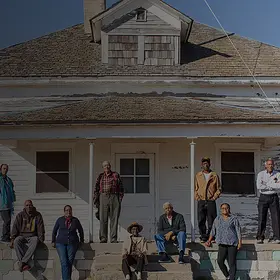
Does your school matter? Take a class picture in front of your older or historic school building and share it with the world through the National Trust's This Place Matters campaign. No camera? No problem! Plant a flag on our interactive map.