'Visiting the Shadows' Teaches the History of the Holidays
By Catherine Schramm
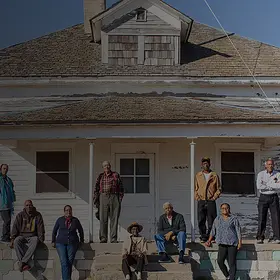
ids today look forward to the holidays as a time for wish lists and days off from school, but we know that this special time of year hasn't always been about trips to the mall and must-have toys. In New Iberia, Louisiana, this important lesson is taught through the story of one of America's most magnificent preserved plantation homes.
Photos of the Shadows
All "Visiting the Shadows" photos courtesy of Shadows-on-the-Teche, a National Trust Historic Site. |
"Hello! My name is Charles Conrad Weeks, but everybody around here calls me Charley. I was born in 1831, and I'm nine years old. This house, and the land around it, is called a plantation because people live and work here. This big house is where I live with my Ma and my three brothers and two sisters. My Ma and my Uncle Alfred grow lots and lots of sugar cane."
Starting the first week of December, this play script can be heard throughout Shadows-on-the-Teche as school buses full of elementary school students arrive to participate in what is for many a first-time visit to a historic site.
Created in 1977, "Visiting the Shadows" allows students of all ages to compare and contrast their lives – and their holiday celebrations and rituals – to those of children who lived in the same community in the nineteenth century.
For the first grade visitors, the site visit is the culmination of several in-class activities and lessons. Prior to setting foot on the Shadows, these students participate in an online presentation that explores everyday life in their community way back when. They also create their own special ornaments based on nineteenth-century reproductions for the site's Christmas tree. The young actors and actresses in the play are generally in grade levels four through six. Though they are slightly older than their first-grade audience, the experience allows them to explore performance techniques and to investigate the lives of the characters they portray.
Added to the program in 1988, the play was created based on the Weeks Family Papers. Members of the Weeks Family were the original owners of the Shadows, and the play focuses on two of their children – Charley and Harriet. In 1991, children of slaves at the Shadows were added to the script to represent a more accurate view of plantation life. The scenes are set within the context of a house tour. The first graders encounter the young actors who explain nineteenth-century life in December, with the sugarcane harvest and holiday celebrations being the main focus.
The play is not the only part of the site visit that gets the students' imaginations going. When they view collections objects, they are able to compare and contrast the objects they use today for the same purposes. Another stop during the visit allows students to grind sugar cubes with reproduced mortars and pestles. They are of course familiar with treats like holiday sugar cookies, and this unique activity allows them to understand the historic process for preparing sugar for use in recipes. This probably explains why the large historic horse-shaped cookie cutter they see during the tour is always a highlight.
The tour ends with the students receiving candy canes as a treat that represents a common holiday element from both the past and the present.
However, the kids are not the only ones who have fun. For the teachers, watching the reactions their students have to the program is extremely rewarding. Take it from Eleanor Dore, who has taught first grade for 37 years and participated in the Shadows program for 32 years – ever since it existed.
"I read the story of Charley Weeks to the students, but I never mention the performers," Dore explains. "When they appear, it is a big surprise."
History is often an intangible concept for younger children (especially first grade students), and it is only through observation and hands-on activities that students gain insight and understanding. What began as a simple program to allow first graders to view the Shadows at Christmas has evolved into a dynamic effort with lesson plans and performance opportunities for students at multiple grade levels. In fact, the complexity of today's program often baffles novices and newbies; this year, 65 classes will visit during just eight days, bringing nearly 100 actors and actresses from 15 different elementary schools. Helping facilitate their experience at the site will be some 85 volunteers.
Through living history, a show-and-tell tour of Shadows-on-the-Teche, and the interactive use of reproduced objects, students leave with first-hand knowledge of how the sugarcane industry and the celebration of the holidays have changed over time.

Catherine Schramm is the curator of education at Shadows-on-the-Teche.
Does your school matter? Take a class picture in front of your older or historic school building and share it with the world through the National Trust's This Place Matters campaign. No camera? No problem! Plant a flag on our interactive map.