Humble Oil Building's Results are Anything But Humble.
San Antonio's Humble Oil Building takes first place after two weeks of voting, with the Hugh Small Grave and Plum Island Boathouse coming in second and third. See below to get each photo's final vote percentage.
![]() |
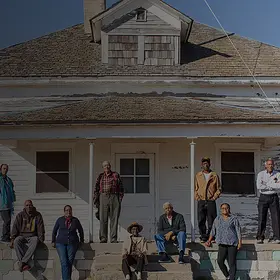
Final Standing: 9.3% Alexandra Caroline at the Bradley-Boggs House Pickens is a small county seat in the Upcountry of South Carolina. In 1868 the district was divided into two counties by the Reconstruction government, so the original courthouse town of Pickens had to be abandoned. Land was selected for the two new courthouse towns and the people packed what they could and moved to one or the other. A very few families of means deconstructed their homes, board by board, brick by brick, and hauled them by mule and oxen on the rutted dirt paths through the woods to their new distant locations. There are two such houses remaining in our town. One is the historic Hagood-Mauldin House that is maintained as a splendid museum by the Pickens County Historical Society. The other is the neglected house in the picture, the Bradley-Boggs House. The people of our town want to see this important place restored and preserved. Alexandra Caroline lives just down the street. She is a young member of our local historical society who believes this home should be returned to its original grandeur and be enjoyed by our community and visitors for generations to come. We love this old house. This is where our forebears lived. This is our past and our future. Thanks for your interest in this place that matters so much to us. |
![]() |
Final Standing: 7.9% Spokane Preservation Advocates "Unveiling" A blend of architectural styles, this granite house in Spokane ’s historic Logan neighborhood was built in 1901 for Elsie and Dr. Charles Thomas, a prominent Spokane physician and surgeon. Now owned by the Coleman-deViveiros family, it is being restored to its original historical appearance. |
|
Final Standing: 12.8% Plum Island Boathouse The Plum Island Boathouse is located in the Death’s Door Passage off the northern tip of Wisconsin’s Door Peninsula between the waters of Lake Michigan and Green Bay. The Coast Guard built the structure in 1939 to house their rescue vessels. Immediately adjacent to boathouse is an 1895 Duluth-Style U.S. Life-Saving Station. A 10-minute hike across the island leads to a set of 1896 range lights and a lighthouse keepers’ dwelling. Maritime history abounds on this 300-acre island. Now part of the Green Bay National Wildlife Refuge, the Friends of Plum and Pilot Islands are working cooperatively with the U.S. Fish and Wildlife Service to support the goals of preservation, restoration, maintenance and contemporary use of the lighthouses,and other historic resources on Plum and Pilot Islands and to conserve and protect wildlife resources, while providing public access to the islands’ history and opportunities for wildlife-dependent recreation. The people in the photo include several Girl Scouts, Fish and Wildlife Service personnel, and a volunteer from the Friends of Plum and Pilot Islands. The Friends of Plum and Pilot Islands received a grant from the National Trust for Historic Preservation last year to fund a the creation of a Building Stabilization Plan. The first phase of the plan was completed when a new roof was put on the nearby Pilot Island Lighthouse. The next phase of the plan is to paint the boathouse which is expected to happen next spring. |
|
![]() |
Final Standing: 9.3% St. Petersburg Shuffleboard Club St. Petersburg Shuffleboard Club, Florida, 1924. In this photo, I tried to capture what the St. Petersburg Shuffleboard Club is like on Friday nights: the lights, the people, the gliding shuffleboard discs. I love it when the courts are full. I love watching all the different groups playing shuffleboard. I especially love that every week more people fall in love with the place. The club, founded in 1924, is the largest shuffleboard club in the world. At its peak in the 1950s, there were more than 5,000 members. The club is an important part of the history of shuffleboard: the game’s modern rules were developed here. The club has always offered competitive and recreational shuffleboard, but by 2005 membership had fallen below 50. A group of enthusiasts, concerned about the condition of the facility, started free Friday night shuffleboard: St. Pete Shuffle. It has been an amazing success. On any given Friday there can be well over 100 people of all ages playing shuffleboard. It is a popular place for families and college kids. Our club membership is increasing. In part due to renewed public interest in the facility, the city of St. Petersburg has begun restoring the club. |
|
Plankhouse Crew at the Star Hotel This photo was taken in front of the Star Hotel in Marcus Hook, PA and features the Plankhouse crew. The Star Hotel is a building owned by myself and my husband Brian Mercadante. It is comprised of 41 rental units and a local tavern. Parts of the building date back to pre-Civil War according to an archeologist who visited. When our nation was in its infancy, local taverns and pubs were the places people met to plan strategies, discuss politics and even elect leaders. With all of the regulating being done in the liquor industry, it is important to remember the role these "Public Houses" had in shaping our country. Marcus Hook is a riverfront borough and has a history filled with pirates. The Plankhouse Crew's mission is to enlighten and educate on the ways of the pirates and local history in terms of the 17th & 18th centuries. For more information on the crew, please visit www.plankhousecrew.com/. |
|
|
Final Standing: 4.5% Morris Avenue Welcome to my old block on Morris Avenue in the Bronx. These houses were designed and built in the years between 1906-1910 to house the growing population; a response to the transit line built in 1904 only a block away. They represent the change of the area form an almost rural landscape to a sub-urban town and, eventually, to an urban city, decorated by a constantly changing cultural fabric. Currently there are mostly low-income families of Hispanic and African American descent living in these houses, as my mom does to this day. These kids, though, do not know, or care, about the socioeconomic's of the Bronx, or that they live in the same house as a Jewish family did over a hundred years ago. The kids know only that it is one of the few tree lined streets in the area, that there's something beautiful about the way the houses are not taller than said trees and that the stoops are perfect for hanging out on during hot summer evening; an oasis in a forest of tenement buildings. They might not be able to articulate why they like it, they don't speak much English, but they know that it is pleasing to look at and comforting to be surrounded by. The reason that I submitted this photo is because I'm glad that I know the meaning of these buildings' history, the importance of their protection, and the value of their presence in the life's of urban kids like these buggers. As I work towards my degree in Historic Preservation I have learned the reasons why I love my block, and wanted to share these guys' appreciation for it with you! |
|
|
Final Standing: 6.3% Miller's Grocery "All American" Places that are for real and totally take you back in time are rare indeed. A little country café honoring the name of what was “Miller’s Grocery” for 75 years is such a place. You can still sit on the old benches on the front porch where friends have gathered for years and a U.S. flag hangs in the window. Inside, the aroma of home-cooking (just like your Grandma used to make) fills the air and city folk and country folk alike come from miles around to gather together in one place to enjoy “comfort” food and good ole southern hospitality. There is no doubt that this place matters! |
|
![]() |
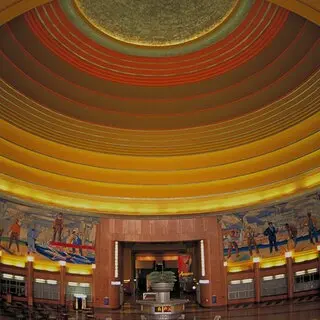
Final Standing: 26.3 % Humble Oil
|
|
Final Standing: 11.5% Hugh Smalling's Grave, Riverside Cemetery Hugh Smalling, the youngest of nine children, joined the Navy in 1938. Hugh’s sister, Rebecca, who is 92 years old and lives near Atlanta, has carefully preserved the photographs and letters that her brother sent home from his travels. On September 9, 1943, Hugh’s ship was sunk by German fire off the coast of Italy. Rebecca’s grandson, Keith Phillips, wrote us, “My great uncle probably died quickly in the fires that broke out when the bombs fell, but the final story I have for you is most compelling. As far as I know, it’s never been shared outside the family. It concerns not only Hugh but his brother, Charles, who was also a veteran of World War II, but as a soldier, not a seaman. On the evening of September 9, 1943, Charles woke up in his tent in the German countryside, screaming “Swim, Hugh, swim-for God’s sake, swim”. Charles had had a nightmare in which he saw the bomb go down the ship’s smokestack. He saw the ship split in half and water pour in on his brother, Hugh. It was not until weeks had passed that Charles learned that his brother had indeed been lost that day. Since then my grandmother remains convinced that psychic ability is real.” We at Historic Riverside Cemetery Conservancy remain convinced that Hugh Smalling’s monument bears witness not only to the story of an idealistic young man and the family who nurtured him, but also it encapsulates the history of the hometown that his contractor father helped to build, and of the nation that fought a war to end the tyranny of the Third Reich. The epitaph on Hugh’s monument bear witness to his family’s love and grief. The anchor and chain symbolize not only Hugh’s military service but also eternal life, heroism, and faithfulness. We have over 17,000 stories in our cemetery. This place matters! |
|
|
Final Standing: 4.9% Save the Hapa Trail It was no easy feat trying to pick photo sites on Kaua'i. Living here, my family and I believe that this entire island is a "place that matters" to us. |
|
|
Final Standing: 2.2% Alaska Founders Monument The Seward, Alaska Founders Monument commemorates the arrival of the steamer Santa Anna and her crew of 35 settlers, 25 railroad employees, 14 horses, a pile driver, sawmill, supplies and equipment that arrived on the shores of Resurrection Bay on August 28, 1903 to found the city of Seward. In 1902, after scouting several potential seaports for the fledgling Alaska Central Railway, John Ballaine selected Resurrection Bay as the most desirable location, beating out a host of other locations, including Valdez, Knik and present day Whittier. The name of Seward was chosen for the new town in honor of William H. Seward, the Secretary of State who negotiated the purchase of Alaska from Russia in 1867. The Santa Anna entered Resurrection Bay the morning of August 28th and the passengers, horses, supplies and equipment were unloaded that afternoon, at the bottom of what is now 5th Ave. The next day, the founders started building the new town, a dock and a railroad. The dream had begun. |
|
|
Final Standing: 2.6% Tuxedo Junction This photograph was taken to continue an ongoing campaign to preserve the heritage of a significant place, Tuxedo Junction, the intersection of two street car lines and the once thriving hub of the African American community of Ensley, the heart of Birmingham’s industrial development. For the thousands of workers in the steel mills and their families, the “Junction” was the center of cultural and commercial activity that became immortalized in the number one hit song “Tuxedo Junction”. An inspiration for future generations, this is the place that fostered the musical careers of Ensley natives such as Erskine Hawkins, Sun Ra, Jothan Callins, and two founding members of The Temptations, Eddie Kendricks and Paul Williams. The Belcher-Nixon Building, the last remaining building at Tuxedo Junction, is associated with professional offices of Dr. John Nixon, Sr. an actor, dentist, and businessman, who played a leadership role in the NAACP’s efforts to combat discrimination in the workforce, specifically the steel industry. The cause needs to continue! |